
Introduction
Japan is home to some of the world’s most advanced robotics and manufacturing technology, yet when it comes to everyday AI adoption inside small and medium-sized enterprises, the country is lagging noticeably behind its developed-economy peers. A recent survey by Rakuten found that only 16% of Japanese SMEs currently use artificial intelligence in their daily operations, a figure that stands out against the pace of AI adoption seen in other advanced economies. For foreign companies operating subsidiaries in Japan, or for Japanese SMEs themselves, understanding why this gap exists matters, because the businesses that close it early will have a real operational advantage over the ones still running on paper and fax machines.
This blog will cover the following points
- How widespread the AI adoption gap actually is among Japanese SMEs
- The five key barriers holding adoption back
- Why traditional workflows and corporate culture play a bigger role than technology cost
- What the OECD’s labour market data reveals about the skills shortage
- Why the right implementation partner matters, and how Sysamic can help
The Scale of the Gap
The Rakuten survey puts a hard number on a problem many people in Japan already sense anecdotally. With only 16% of SMEs using AI day to day, the vast majority of small businesses have not integrated even basic generative tools into their operations. This is not a niche issue confined to the smallest or most rural businesses either. It cuts across sectors, from retail to manufacturing to professional services, and it comes at a moment when Japan’s shrinking working-age population makes the productivity gains AI can offer more valuable than almost anywhere else in the developed world.
Key Barriers to AI Adoption
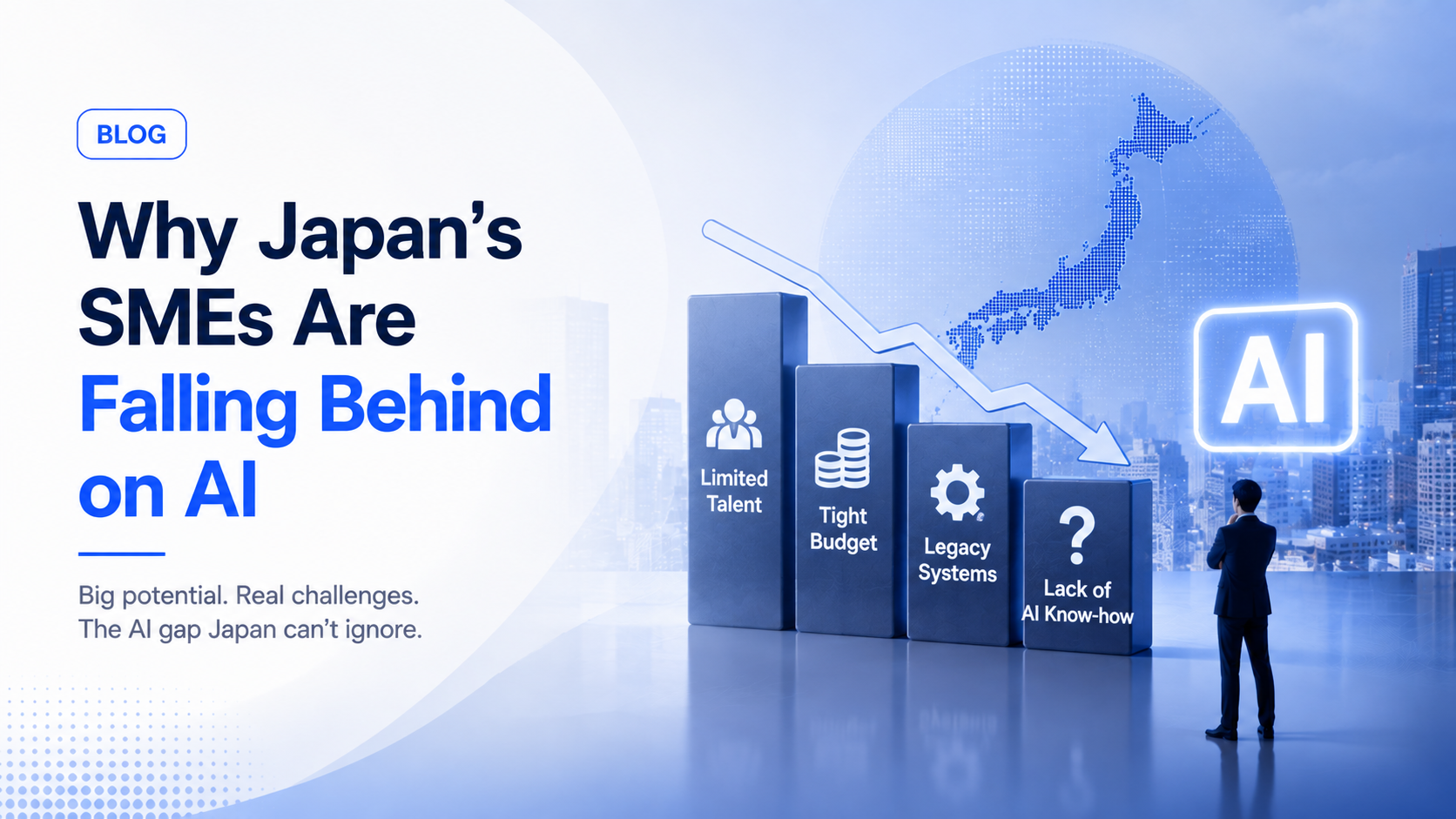
Five structural issues explain most of the gap. The first is an awareness and knowledge gap, with roughly 40% of non-using SME owners entirely unaware of the practical benefits AI can provide, meaning many businesses have not even reached the stage of evaluating a tool, let alone rejecting one. The second is a lack of skilled labor, which OECD data confirms directly, showing that Japanese employees and managers frequently cite a shortage of digital skills as a primary roadblock to using generative tools even when they want to. The third is traditional workflows, since many small businesses still rely on paper documents, physical hanko seals, and fax machines, creating a digital divide that has to be crossed before AI adoption is even possible. The fourth is cost and ROI concerns, as business owners hesitate to invest capital when the upfront costs feel high and the financial return feels uncertain. The fifth is Japan’s seniority and generalist corporate culture, where traditional structures favor broad career paths and seniority-based promotion over specialized, job-based technical roles, leaving fewer people whose job is specifically to drive technology adoption.
What the OECD Data Adds
The OECD’s research on AI and the labour market in Japan reinforces that this is fundamentally a skills problem as much as a technology or budget problem. Japanese companies report struggling with a lack of talent that has the necessary workplace experience and basic AI knowledge, which means simply buying software licenses does not solve the underlying issue. Without people who understand how to configure and apply the tools to real business processes, even a well-funded AI initiative stalls at the pilot stage.
Why This Matters for Foreign Subsidiaries
Foreign companies operating in Japan face this gap from a different angle. Many arrive with modern AI-enabled systems already standard in their home markets, only to find that local staff, suppliers, and even their own Japan-based finance team are working around legacy paper-based processes. Closing that gap does not require building AI from scratch. It usually means bringing AI capability into the systems a company already runs, such as ERP and reporting tools, where automation can be introduced gradually and in a way staff can actually adopt.
Conclusion
Japan’s SME AI gap is not primarily a technology problem, it is a knowledge, skills, and workflow problem, which means the fix has to start with practical, well-supported implementation rather than simply purchasing another tool. Businesses that pair AI adoption with the right training and system setup will be the ones that actually see the productivity gains everyone else is still waiting for.
Sysamic K.K. is a Tokyo-based Microsoft Dynamics 365, Power BI, and Business Central partner with more than 20 years of experience helping international and Japanese businesses modernize their operations. We help clients introduce AI capabilities like Copilot and Power BI’s agentic features into their existing systems in a way that fits Japan’s accounting environment, bilingual reporting needs, and day-to-day workflows, rather than asking teams to adopt AI from a standing start. If your business wants help closing the AI adoption gap without disrupting how your team already works, we would be glad to help. Email us at info@sysamic.com or fill out our contact form here to get in touch.