
Introduction
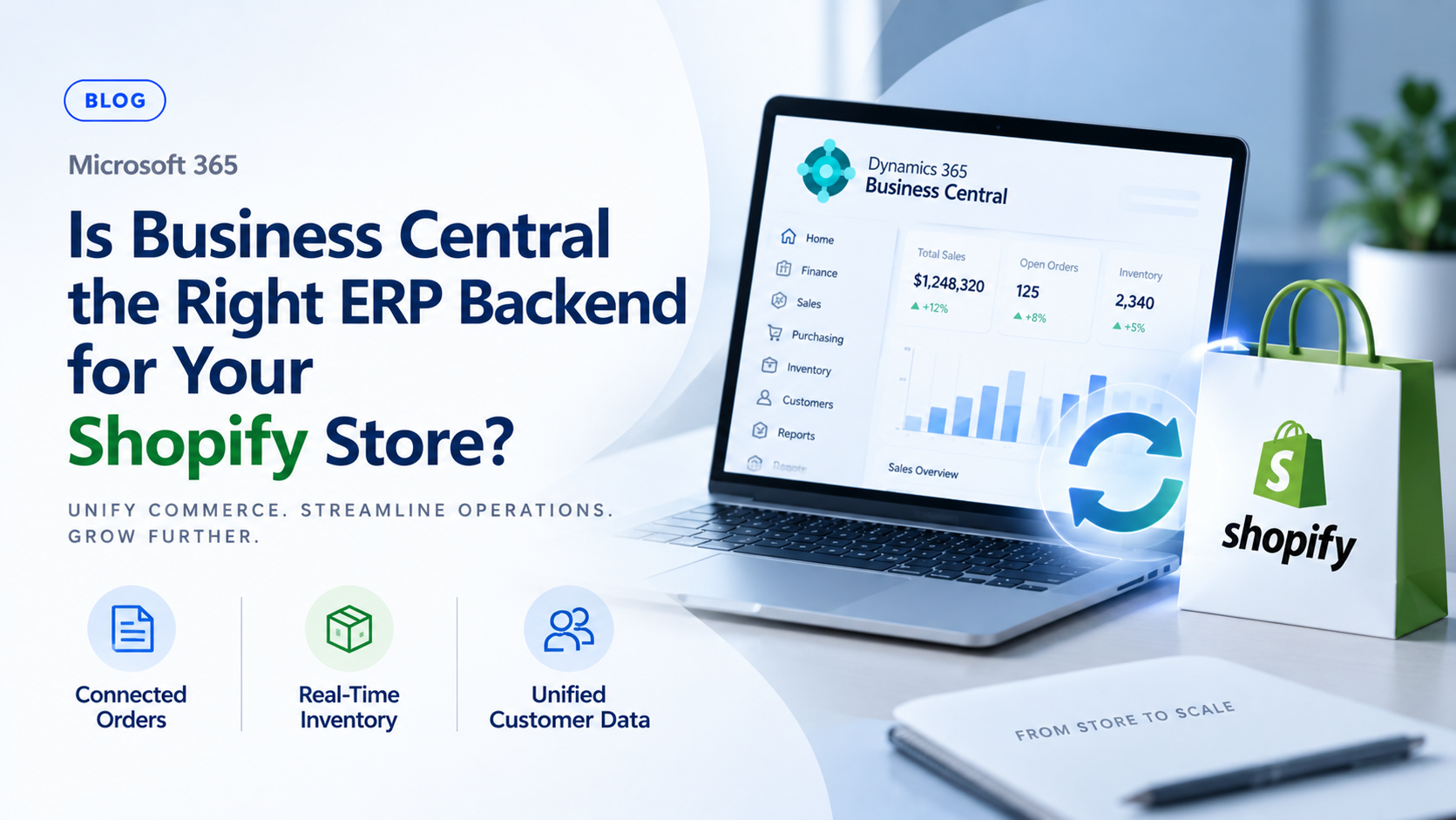
Choosing an ERP backend for a Shopify store is not a one-size-fits-all decision, and the businesses that get it wrong usually do so in one of two directions. Some adopt a heavyweight ERP long before they actually need one, and others stay on lightweight tools well past the point where manual processes are costing them real money. Microsoft Dynamics 365 Business Central is a strong ERP backend for a Shopify store if you need advanced inventory, multi-warehouse management, and deep financial control, but that fit depends entirely on how complex your operations actually are. This blog walks through how to evaluate that fit honestly before committing to an implementation.
This blog will cover the following points
- When Business Central genuinely fits a Shopify store’s needs
- When a business should avoid Business Central, at least for now
- The main integration methods available: connectors versus custom APIs
- Signs your business has outgrown a lightweight or native setup
- Why the right implementation partner matters, and how Sysamic can help
When Business Central Fits Your Store
Four signals consistently point toward Business Central being the right choice. Complex inventory needs, where a business manages stock across multiple warehouses, physical retail locations, and online channels simultaneously, are difficult to handle well in Shopify alone. Global operations that require multi-currency accounting, local tax compliance, and multi-language support push most lightweight tools past their limits quickly. Deep ERP needs, including advanced manufacturing, job costing, or supply chain workflows that go beyond basic order and inventory tracking, are exactly what Business Central was built to handle. Finally, businesses already invested in the Microsoft ecosystem, using Office 365, Power BI, or Dynamics 365 Sales, get a natural advantage from a backend that shares the same platform and data model rather than bolting on yet another disconnected tool.
When to Avoid Business Central
Just as important is recognizing when Business Central is the wrong call, at least for now. A business with simple operations, a single warehouse, and only basic accounting needs is unlikely to see a return on the setup effort an ERP implementation requires. A high implementation cost is also a real barrier for businesses with a small budget or without the IT resources to support a lengthy setup and ongoing maintenance. And in some cases, the basic needs are already met, meaning native Shopify admin tools or lighter apps already handle order management adequately, and introducing an ERP would add complexity without solving an actual problem.
Integration Methods: Connector Apps and Custom APIs
Once a business has decided Business Central fits, the next decision is how to connect it to Shopify. Connector apps, whether Microsoft’s native option or a certified third-party connector, link Shopify and Business Central quickly without custom code, which makes them the right starting point for most standard retail and B2B setups. Custom APIs are the alternative for businesses with unique data workflows that a pre-built connector cannot accommodate, since Business Central exposes a clean REST API that developers can build against directly, an approach that suits complex distribution, multi-marketplace, or highly specific pricing and fulfillment logic.
Signs You’ve Outgrown the Native Connector
Businesses that start with Microsoft’s free native connector often reach a point where its coverage stops matching their operational complexity. Common signs include selling across multiple storefronts or marketplaces beyond a single Shopify shop, needing precise handling of variant products with many size and color combinations, running frequent partial refunds or returns that need to reconcile cleanly with accounting, or operating across multiple currencies where automated tax and currency handling becomes essential rather than optional. When these patterns show up, a certified third-party connector or a custom API integration typically closes the gap the native connector was never designed to cover, without requiring a full ERP replacement.
Conclusion
The right answer to whether Business Central belongs behind your Shopify store depends less on the size of your business and more on the actual complexity of your inventory, operations, and growth plans. Getting that evaluation right before committing to an implementation is what determines whether the ERP becomes a genuine operational advantage or an expensive tool that outpaces what the business actually needs.
Sysamic K.K. is a Tokyo-based Microsoft Dynamics 365 Business Central partner with more than 20 years of experience helping companies evaluate, implement, and integrate the right ERP setup for their operations. We help clients honestly assess whether Business Central fits their Shopify store, and if it does, we configure the connector or custom integration approach that matches their actual complexity rather than over-building the solution. If your team is weighing whether Business Central is the right ERP backend for your store, we would be glad to help. Email us at info@sysamic.com or fill out our contact form here to get in touch.