
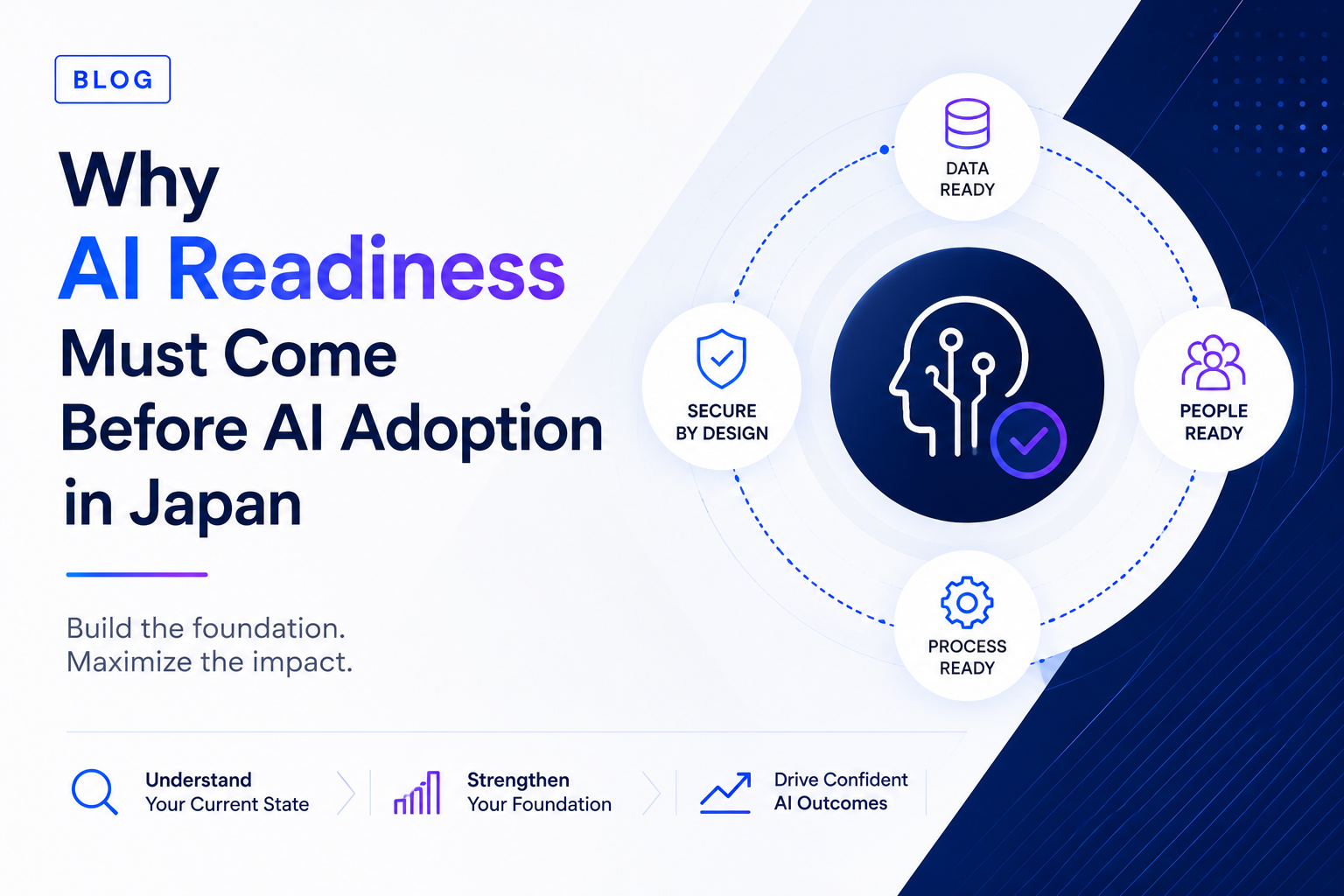
This blog will cover the following points
- What AI readiness means and how it differs from AI adoption
- Why the readiness gap is especially wide in Japan
- The four foundations of AI readiness for businesses in Japan
- How your ERP environment determines your AI success
- How Sysamic helps companies become AI ready before they adopt
Introduction
Japan is investing in artificial intelligence at a historic pace. AI infrastructure spending is set to cross 5.5 billion US dollars in 2026, and the government estimates AI could unlock nearly 50 trillion yen in economic value by 2030. Yet inside most Japanese organisations, the picture is very different. Awareness of AI is almost universal, but only around 8 percent of companies have reached full-scale deployment. The rest remain stuck in pilots and partial rollouts.
The reason is rarely the technology itself. It is readiness. Companies that adopt AI before preparing their data, systems, governance, and people end up with stalled pilots, compliance risks, and tools nobody trusts. For businesses operating in Japan, where expectations around quality, accuracy, and data security are among the highest in the world, skipping readiness is not just inefficient. It is a genuine business risk.
AI readiness vs AI adoption: the difference that matters
AI adoption is the act of deploying AI tools, whether that is Copilot, a chatbot, or automated forecasting. AI readiness is how well prepared your organisation is to make those tools succeed. It covers the quality and accessibility of your data, the modernity of your core systems, your governance and compliance posture, and the skills and confidence of your workforce.
Research on Japanese enterprises shows a telling imbalance. Technical readiness sits around 49 percent while organisational readiness lags at 42 percent, reflecting change management hurdles such as leadership buy-in and skills. In other words, many companies buy the technology before the organisation is prepared to absorb it. Adoption without readiness produces activity, not value.
Why the readiness gap is wider in Japan
Japan presents unique conditions that make readiness non-negotiable.
First, quality expectations are exceptionally high. Japanese customers and business partners operate on a standard of precision and hospitality known as omotenashi. An AI system that produces inaccurate outputs or poorly localised Japanese damages trust quickly, and trust is hard to rebuild.
Second, risk sensitivity is real. A large majority of Japanese CFOs cite data leakage, regulatory compliance, and accuracy as their top AI concerns. With the new AI Promotion Act shaping Japan’s soft-law regulatory framework, governance can no longer be an afterthought.
Third, legacy systems remain widespread. Many companies still run ageing ERP platforms, on-premise servers, and fragmented Excel-based processes. AI cannot deliver reliable insight when the underlying data is scattered, inconsistent, or locked in silos.
Fourth, demographics add urgency. Japan’s shrinking workforce makes AI-driven productivity essential, but employees need training and clear governance to trust and use these tools well.
The four foundations of AI readiness
For most companies in Japan, becoming AI ready comes down to four foundations.
A clean, connected data layer. AI is only as good as the data feeding it. That means consolidating financials, inventory, sales, and operations into a single reliable source of truth rather than disconnected spreadsheets and legacy databases.
A modern ERP core. A cloud platform such as Microsoft Dynamics 365 Business Central provides structured, real-time business data that AI tools can actually use, while handling Japan-specific requirements such as consumption tax, invoicing rules, and local compliance.
Governance and security. Clear policies on data access, retention, and AI usage protect your business and satisfy both Japanese regulators and overseas headquarters.
People and process. Workflows should be mapped and standardised, often with tools like Power Automate, so AI augments well-defined processes rather than automating chaos. Staff need practical training in both English and Japanese.
Your ERP is your AI launchpad
This is the point most companies miss. AI initiatives fail or succeed based on the systems beneath them. When your ERP, reporting through Power BI, and automation layer are properly implemented, adding AI capabilities such as Copilot or Claude-powered workflows becomes a natural next step instead of a risky leap. Readiness is not a delay to AI adoption. It is the fastest safe route to it.
Conclusion
AI adoption in Japan is accelerating, but the winners will be the companies that prepared first. Building your data foundation, modernising your ERP, and establishing governance turns AI from an experiment into a dependable business capability.
Sysamic K.K. is a Tokyo-based Microsoft partner helping European and North American companies in Japan become AI ready. From Business Central implementation and Power BI analytics to Power Automate workflows and AI integration, we build the foundation your AI strategy needs, with bilingual support and deep knowledge of Japanese compliance. Email us at info@sysamic.com or fill out our contact form here (https://sysamic.com/en/contact/) to get in touch.