
Introduction
For foreign companies setting up operations in Japan, one of the first questions that comes up is whether their ERP system will actually work the way local staff, accountants, and auditors expect it to. Microsoft Dynamics 365 Business Central has answered that question through a growing ecosystem of Japanese localization extensions, commonly marketed as a 日本語版 or “Japanese version” of the platform, available through Japan-based Microsoft partners on AppSource. Understanding what these localization packages actually include, and what they leave for an implementation partner to configure, is the difference between a smooth rollout and months of workarounds after go live.
This blog will cover the following points
- What a Japanese localization release of Business Central actually includes
- How the Japanese Language Kit differs from a fully localized accounting setup
- Core business functions covered: sales, procurement, finance, and inventory
- Why localization extensions vary between Japan-based Microsoft partners
- Why the right implementation partner matters, and how Sysamic can help
What a 日本語版 Release Actually Includes
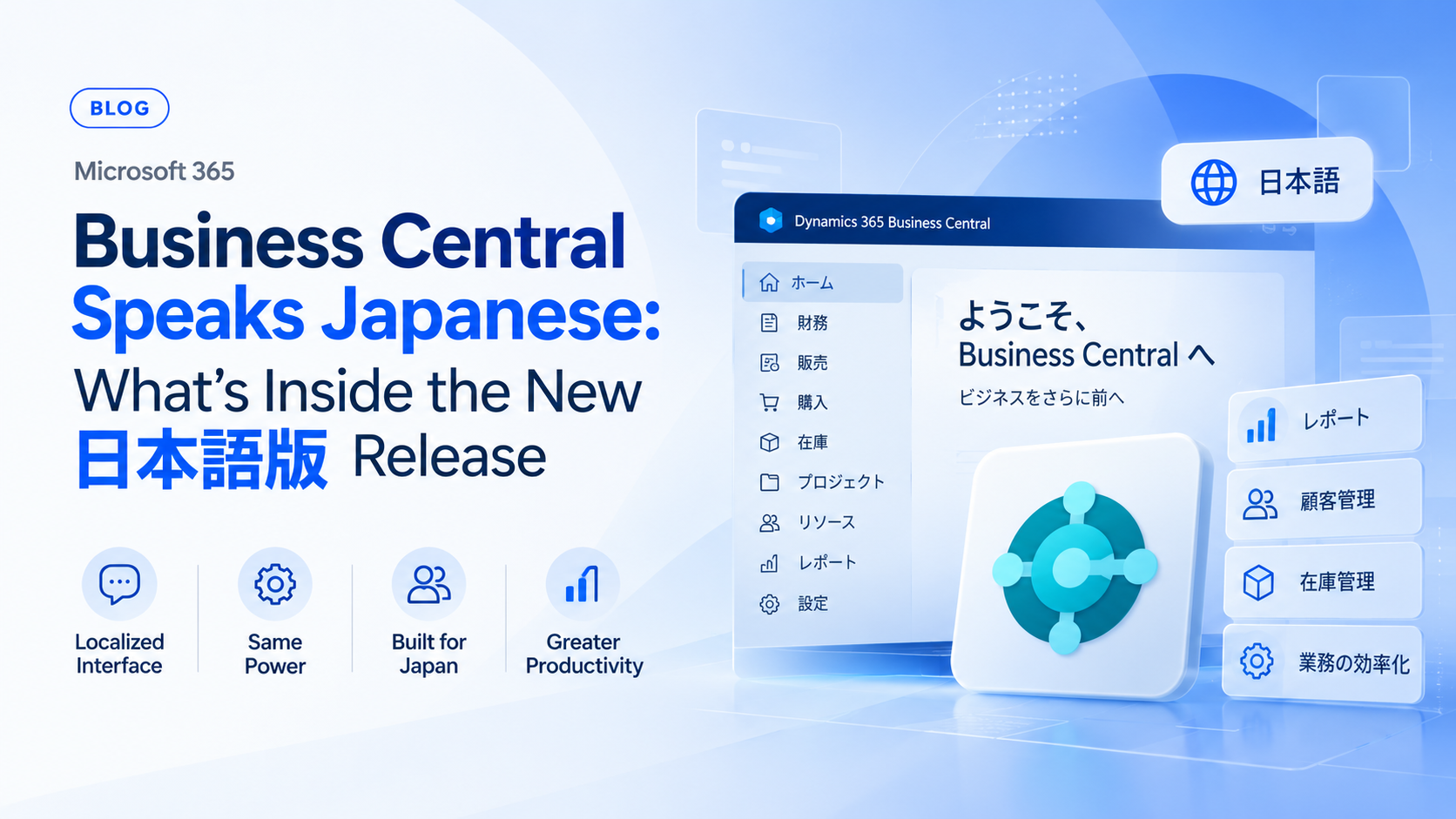
Japan-based Microsoft partners publish Business Central localization packages through Microsoft AppSource, and these typically center on a Japanese Language Kit extension layered on top of the core Business Central platform. Rather than being a separate product, this is an extension that translates the interface and adds Japan-specific business logic to the same cloud-based ERP system used globally. Published packages describe the result as a comprehensive, cloud-based, all-in-one business management system, and most vendors offer a free trial period so companies can test the localized version before committing to a contract.
Language Kit Versus Full Localization
It is worth separating two things that often get bundled under the same marketing language. A Japanese Language Kit primarily handles interface translation, menu labels, and terminology so Japanese-speaking staff can navigate the system naturally. Full localization goes further, addressing the accounting and compliance layer that Japanese law and Japanese accounting practice actually require, including J-GAAP aligned chart of accounts structures, consumption tax handling, and support for the Qualified Invoice System requirements that took effect in recent years. A company that only implements the language kit without the deeper accounting localization can end up with a Business Central instance that reads correctly in Japanese but still produces reports that do not reconcile the way a Japanese auditor or tax office expects.
Core Business Functions Covered
Localized Business Central packages generally extend across the same core modules that make up the platform everywhere else. Sales and customer management, procurement management, financial accounting, inventory management, production management, and project management all carry Japan-specific configuration where it matters, such as tax code handling on sales and purchase documents, supplier registration number validation, and reporting formats that match what Japanese banks and tax authorities expect to see. For a foreign subsidiary running global operations alongside a Japan entity, this means the same underlying platform can serve both without forcing a separate system just for the Japan office.
Why Localization Varies Between Partners
Not every Japanese localization extension is built the same way, and this is where companies most often run into trouble. Because Business Central’s Japan localization has historically relied on partner-built extensions rather than a single native Microsoft release, the depth of coverage, update cadence, and quality of support varies significantly from one publisher to another. A company evaluating a 日本語版 offering should look closely at what accounting and compliance logic is actually built in, not just whether the interface displays in Japanese, and should confirm the extension is actively maintained as Microsoft rolls out new Business Central versions each year.
Conclusion
A Japanese localization release of Business Central can genuinely close the gap between a global ERP platform and the day-to-day expectations of running a compliant business in Japan, but only when the extension goes beyond translated menus into real accounting and tax logic. Evaluating that depth before signing a contract is what separates a system that works quietly in the background from one that creates reconciliation problems every month end.
Sysamic K.K. is a Tokyo-based Microsoft Dynamics 365 Business Central partner with more than 20 years of experience helping North American and European companies implement and localize Business Central for Japan operations. We build and maintain localization extensions that go beyond language translation, covering J-GAAP aligned accounting, consumption tax and invoice system compliance, and bilingual reporting, so our clients get a system that works correctly for both headquarters and their Japan entity. If your team is evaluating a Japanese localization of Business Central or wants a second look at an existing setup, we would be glad to help. Email us at info@sysamic.com or fill out our contact form here to get in touch.