
Introduction
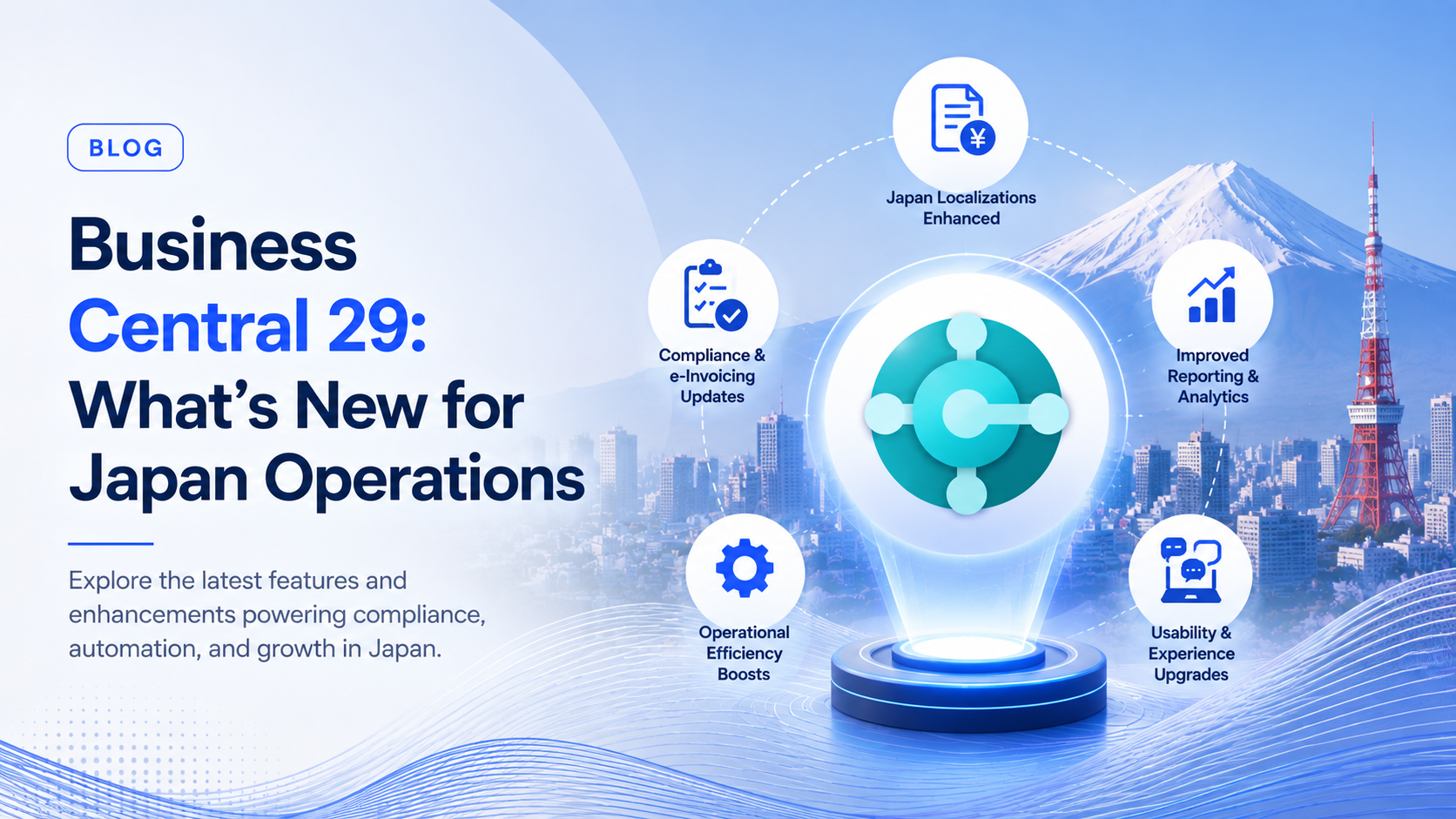
Microsoft Dynamics 365 Business Central version 29, part of the 2026 release wave 2, is set for general availability in October 2026. For companies running Japan operations on Business Central, this update brings more than routine maintenance. It touches multi currency management, AI driven financial workflows, and the localization framework that Japanese subsidiaries depend on for compliant, accurate reporting. With early access previews already opening in September 2026 and updates rolling out through March 2027, now is the time for finance and IT teams to understand what is changing and how to prepare.
This blog will cover the following points
- The BC 29 release timeline and rollout schedule
- Key new capabilities for multi currency and multi entity management
- AI driven financial workflows and where they fit into Japan operations
- How Japan localization works within the Business Central framework
- Administrative and audit enhancements worth knowing about
- Why the right implementation partner matters, and how Sysamic can help
Release Timeline and Core Focus
Business Central 29 carries version number BC29 and follows the standard Microsoft twice yearly release cadence. General availability begins in October 2026, with early access previews opening the prior month so partners and customers can test changes before they go live. Microsoft will continue rolling out incremental updates through March 2027. For businesses with a Japanese headquarters or subsidiary, this timing lines up closely with other regulatory shifts happening the same quarter, including the October 2026 changes to Japan’s Qualified Invoice System transitional tax credit rules, so IT teams juggling both should plan a combined readiness review rather than treating them separately.
Key Capabilities for Japan and Global Operations
Four areas stand out for companies managing Japan alongside other regions. The first is multi currency and multi entity management. BC29 streamlines automated exchange rate adjustments, financial consolidation, and multi currency postings, which matters directly for Japanese headquarters that need to track local operations in yen alongside overseas currencies without manual reconciliation.
The second is AI driven financial workflows. Building on the human in the loop AI agents introduced in earlier waves, BC29 extends automation to accounts payable, sales orders, and expense processing. For Japan based finance teams already stretched by labor constraints, this reduces manual data entry on repetitive tasks while keeping a human checkpoint on anything that needs judgment.
The third is the localization framework itself. Unlike some regions, Japan localization for Business Central has historically relied on partner driven or W1 based extension models rather than a fully native Microsoft build. This makes the choice of implementation partner especially important, since the extension needs to stay adaptable as Japanese tax and regulatory requirements evolve, including consumption tax handling, qualified invoice validation, and J-GAAP aligned reporting.
The fourth is administrative and audit tooling. BC29 enhances audit functionality across user groups and permissions, supporting the kind of rigorous reporting that SOX and similar frameworks demand, alongside company level index usage management for better database performance as transaction volumes grow.
Why This Matters Now
Companies sometimes treat an ERP version upgrade as a purely technical exercise for the IT department. For Japan operations, that view misses the point. A localization framework depends on the partner extension keeping pace with the underlying platform, and an update of this scale is exactly the moment where gaps show up, whether that is a tax table that was never migrated, a multi currency posting rule built for an older version, or an audit permission structure that has not been reviewed in years. Testing early, ideally during the September 2026 preview window, gives finance teams a real chance to catch these issues before general availability rather than after.
Conclusion
Business Central 29 is not a routine patch. Between the multi currency improvements, expanded AI agents, and continued reliance on a partner maintained localization framework, this release asks Japan operations to plan ahead rather than wait for issues to surface after go live. Testing early, keeping the localization extension current, and reviewing audit permissions before general availability will save far more time than fixing problems after the October 2026 rollout.
Sysamic K.K. is a Tokyo-based Microsoft Dynamics 365 Business Central partner helping international companies run compliant, well-configured Japan operations. We implement Business Central, localization extensions, and Power BI integrations with full attention to Japan’s accounting environment, multi currency reporting, and the tax and audit requirements that make Japan subsidiaries operationally distinct. Our team has guided clients across retail, apparel, and footwear through past Business Central upgrades, and we are already preparing our customers’ Japan localization extensions for BC29. If your team wants a readiness assessment before the rollout, we would be glad to help. Email us at info@sysamic.com or fill out our contact form here to get in touch.