
This blog will cover the following points:
- Introduction
- Why “Plug-and-Play” Global Rollouts Fail in Japan
- Layer 1: The Foundation — Global ERP and Standardised Platforms
- Layer 2: The Middle — Localised Business Process Automation
- Layer 3: The Front End — Reporting, Visibility, and User Adoption
- What This Looks Like in Practice
- Conclusion
Introduction
Setting up operations in Japan as a foreign company is rarely straightforward. The business culture is distinct, the compliance environment is demanding, and the gap between global headquarters expectations and local operational reality can be wide.
Technology is supposed to bridge that gap. But for too many European and North American companies, a Japan subsidiary rollout of their global ERP or automation platform quickly runs into trouble. The system works fine at headquarters. In Japan, it creates friction, workarounds, and quiet resistance.
The reason is almost always the same: the implementation treated Japan like every other market.
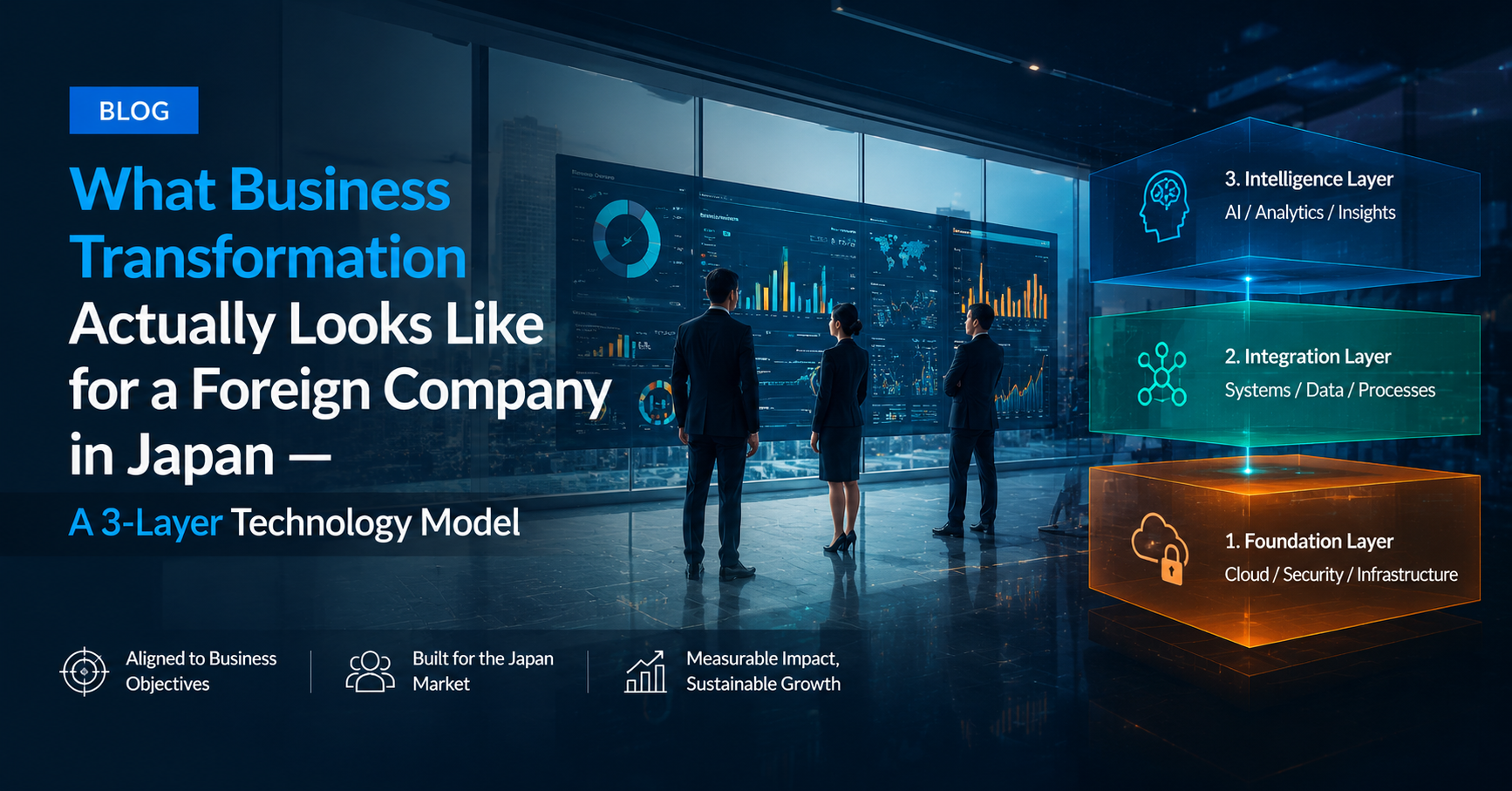
What actually works is a structured, three-layer approach that deploys global platforms at the foundation, automates localised business processes in the middle, and drives adoption through visibility tools at the front end. This blog walks through each layer, why it matters in the Japanese context, and what it means in practice.
Why “Plug-and-Play” Global Rollouts Fail in Japan
Japan’s business environment has characteristics that global system templates rarely account for.
Decision-making in Japanese organisations traditionally follows the Ringi system, a consensus-based approval process where proposals circulate through multiple departments before a decision is reached. This process can take weeks due to multiple reviews, with delays often caused by bottlenecks in the approval chain. A global ERP configured for a two-step approval workflow simply does not reflect how decisions are actually made on the ground.
Many Japanese companies still rely on outdated systems, and 60% of IT systems in Japan are expected to be over 20 years old by 2025, making compatibility a crucial consideration for foreign companies entering the market.
Add bilingual documentation requirements, Japanese tax and accounting standards, and a workforce that expects technology to adapt to their processes rather than the other way around, and the scope of the localisation challenge becomes clear.
The 3-Layer Technology Model exists precisely to address this reality.
Layer 1: The Foundation – Global ERP and Standardised Platforms
The first layer is about establishing a single, standardised system of record that headquarters can trust and that the Japanese subsidiary can actually use.
For foreign companies in Japan, Microsoft Dynamics 365 Business Central has emerged as the practical choice. This creates a natural pathway for Dynamics 365 ERP and CRM adoption, especially among companies that want ERP to connect with collaboration, analytics, automation, AI agents, and low-code workflows.
The critical principle at this layer is that standardisation does not mean rigidity. The foundation must be configured to accommodate Japanese accounting standards, local tax rules, Japanese-language document templates, and multi-entity reporting across the parent company and subsidiary. Japanese branches and partners of North American and European enterprises are required to follow compliance with both country and company standards, which may be significantly different.
Getting this layer right means the rest of the transformation has something solid to build on. Getting it wrong means every subsequent layer inherits the same gaps.
Layer 2: The Middle – Localised Business Process Automation
The second layer is where most business transformation projects either gain momentum or stall completely.
Japan’s operational processes are shaped by habits that have real business logic behind them: detailed record-keeping, formal approval chains, and a preference for methodical, documented workflows. The mistake is trying to eliminate these habits. The correct approach is to digitise them without destroying what makes them work.
Microsoft Power Automate is the primary tool at this layer. A well-designed Power Automate implementation can:
- Digitise the Ringi approval process, allowing simultaneous review and mobile sign-off while preserving the consensus structure
- Automate bilingual document generation for vendor contracts, purchase orders, and compliance reports
- Connect Business Central events directly to Teams notifications, keeping Japanese teams informed within the tools they already use
- Integrate with external Japanese business systems and portals that global platforms do not natively support
Ringi-sei is increasingly being replaced by digital workflow tools including Microsoft Power Automate, with fewer approvers and decisions moving in weeks instead of months, especially when leadership is visibly involved. This is the opportunity. Automation does not have to fight Japanese business culture. Designed correctly, it accelerates it.
Layer 3: The Front End – Reporting, Visibility, and User Adoption
The third layer turns data into decisions and technology into something the organisation actually wants to use.
Foreign companies operating in Japan face a persistent challenge: headquarters needs consolidated reporting in English, while the local team works in Japanese and measures performance differently. Power BI is the tool that resolves this tension.
A well-configured Power BI environment connected to Dynamics 365 Business Central gives headquarters real-time visibility into Japan operations, while giving the local team dashboards that reflect their own KPIs, language, and reporting cadence. It removes the manual Excel consolidation that consumes hours of finance team time every month and creates a shared language of performance between Tokyo and headquarters.
This layer also drives adoption. When local teams see their own data presented clearly, when managers can answer questions about Japan operations without waiting for a monthly report, and when decisions visibly improve because of the system, resistance softens. The technology stops being something imposed from outside and becomes something the team owns.
What This Looks Like in Practice
A European manufacturer with a Japanese subsidiary implements Business Central as the ERP foundation, replacing a legacy local accounting system. Power Automate handles the purchase approval workflow, replicating the existing Ringi process digitally and cutting approval time from two weeks to three days. Power BI delivers a bilingual executive dashboard that headquarters accesses in real time.
A North American professional services firm uses the same stack to automate client invoice generation in both Japanese and English, route approvals through Teams, and surface project profitability data for both the Tokyo office and the global CFO.
In both cases, the transformation is not about replacing Japanese business practices. It is about giving them a better infrastructure.
Conclusion
Business transformation for a foreign company in Japan is not a single-step project. It is a layered process that must account for the unique compliance environment, business culture, and operational habits of the Japanese market.
The 3-Layer Technology Model provides a framework that works: a global ERP foundation configured for Japan, localised automation in the middle, and reporting and adoption tools at the front end. Each layer reinforces the others, and the Microsoft stack of Business Central, Power Automate, and Power BI makes the entire architecture coherent, integrated, and scalable.
Sysamic K.K. is a Tokyo-based Microsoft Dynamics 365 partner specialising in exactly this kind of implementation. We have helped European and North American companies successfully deploy Business Central, Power Automate, and Power BI in their Japan operations, with full attention to local compliance, bilingual requirements, and the cultural context that makes Japan unique. Our team bridges the gap between global headquarters expectations and what actually works on the ground in Japan.
If your company is planning a technology transformation in Japan, or struggling with an existing rollout, we would be glad to help, mail us at info@sysamic.com or fill out our contact form here to get in touch.