
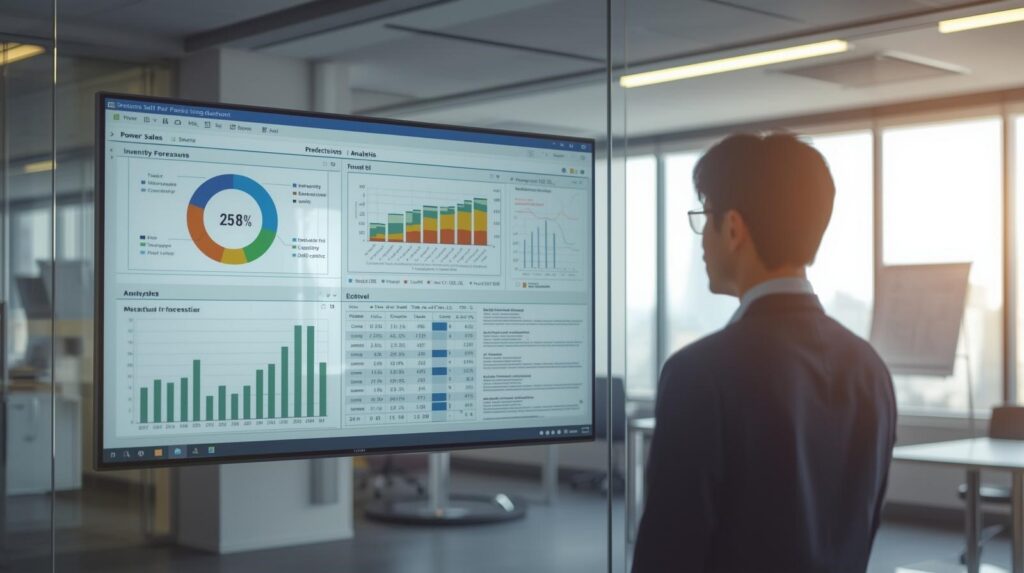
Predictive Sales and Inventory Forecasting with Power BI and Dynamics 365 Business Central
This blog will cover following points
Why forecasting is becoming a strategic priority for Japanese businesses
Why traditional forecasting often fails
What predictive forecasting actually means
How Business Central provides the data foundation
Key forecasting scenarios Japanese companies use
Why Power BI is ideal for predictive analytics
How predictive forecasting improves business outcomes
Why Japanese companies benefit from localized analytics expertise
The future of forecasting with AI and business intelligence
Final thoughts
Why forecasting is becoming a strategic priority for Japanese businesses
Many companies in Japan still manage sales forecasting and inventory planning using spreadsheets. The process usually involves exporting data from Microsoft Dynamics 365 Business Central, manipulating numbers manually, and trying to predict demand based on past experience. But markets are no longer predictable. Customer demand shifts quickly. Supply chains fluctuate. Currency changes affect procurement decisions. And product lifecycles move faster than ever. This is where predictive forecasting becomes essential.
When Microsoft Power BI is integrated with Business Central, companies gain the ability to analyze historical patterns, detect trends, and forecast future demand with far greater accuracy. Instead of reacting to sales changes after they happen, organizations can start anticipating them. And that changes how decisions are made.
Why traditional forecasting often fails
Before discussing predictive forecasting, it helps to understand why traditional forecasting struggles.
Many organizations rely on three approaches:
• Historical averages
• Manual spreadsheet calculations
• Sales team intuition
These methods can work in stable markets. But they struggle when conditions change.
For example:
A sudden increase in demand may cause stock shortages.
Overestimating demand can lead to excess inventory.
Seasonal fluctuations may not be properly accounted for.
In industries such as manufacturing, wholesale distribution, and retail — which are common sectors using Microsoft Dynamics 365 Business Central — these forecasting mistakes directly affect profitability.
Inventory that sits too long ties up working capital. Inventory shortages damage customer trust. Predictive analytics helps avoid both problems.
What predictive forecasting actually means
Predictive forecasting is not about guessing future numbers. It is about using data patterns to estimate likely outcomes. When Microsoft Power BI analyzes historical data from Business Central, it can identify trends such as:
• Seasonal demand patterns
• Sales growth trends
• Product lifecycle curves
• Customer purchasing behavior
• Inventory turnover rates
Using these signals, Power BI can generate forecasts that continuously update as new data enters the system. This creates a much more reliable planning process.
How Business Central provides the data foundation
A forecasting system is only as strong as its data source. Business Central already stores the critical information required for forecasting:
Sales data
Purchase orders
Inventory levels
Customer demand history
Lead times
Supplier performance
When these datasets are connected to Microsoft Power BI, companies can build forecasting models without exporting spreadsheets or maintaining separate databases.The result is a single, reliable source of truth. For Japanese companies managing complex supply chains or multi-location inventory, this centralized data becomes extremely valuable.
Key forecasting scenarios Japanese companies use
Organizations in Japan typically use predictive analytics for several operational decisions.
Sales forecasting: Sales leaders want to answer questions such as:
How much demand should we expect next quarter?
Which product categories are growing?
Which customers are likely to increase orders?
Power BI can analyze sales data trends and generate forward-looking projections directly from Business Central. This helps leadership teams plan production and procurement more accurately.
Inventory demand forecasting: Inventory forecasting answers questions like:
How much stock should we keep next month?
Which products may run out soon?
Where should we increase safety stock?
Predictive models can combine historical sales patterns with inventory turnover metrics. This helps companies avoid both stockouts and overstock situations.
Seasonal demand planning
Seasonal demand plays a major role in industries such as retail and manufacturing. Predictive analytics can detect recurring demand spikes and adjust inventory levels accordingly.
For example:
• Holiday shopping periods
• Fiscal year closing procurement spikes
• Industry-specific seasonal sales patterns
Instead of reacting to demand, companies prepare for it.
Why Power BI is ideal for predictive analytics
There are many analytics tools available today. But Microsoft Power BI has several advantages when used with Business Central.
Built-in forecasting capabilities: Power BI includes forecasting algorithms that can automatically analyze historical data trends. Users can create projections directly within dashboards.
Real-time data connectivity: Because Power BI connects directly with Microsoft Dynamics 365 Business Central, dashboards update automatically when ERP data changes. This means forecasts evolve continuously rather than remaining static reports.
Interactive decision dashboards: Executives and operations managers can interact with dashboards to explore different scenarios.
For example:
What happens if demand increases by 10%?
What if supplier lead times change?
What if a product launch drives new demand?
These insights help leadership teams make faster decisions.
How predictive forecasting improves business outcomes
When predictive forecasting is implemented effectively, companies see improvements across multiple areas.
Better inventory control: Organizations can maintain optimal stock levels while reducing excess inventory.
Improved working capital management: Lower inventory levels free up capital that can be used for growth investments.
Faster decision making: Executives no longer rely solely on static reports. Real-time analytics enables data-driven planning.
Improved supply chain resilience: Predictive insights help companies prepare for demand fluctuations before they impact operations.
Why Japanese companies benefit from localized analytics expertise
Technology alone does not guarantee successful forecasting.
Implementation requires understanding:
Japanese accounting structures
Local supply chain patterns
Language requirements for dashboards
Business workflows common in Japan
This is where experienced partners become critical. A partner familiar with Microsoft Dynamics 365 Business Central and Japanese business practices can design forecasting dashboards that match local operational needs.
At Sysamic, predictive analytics solutions are designed specifically for organizations operating in the Japanese market. The focus is not just on dashboards — but on creating practical insights that operational teams can actually use.
The future of forecasting with AI and business intelligence
Forecasting is evolving rapidly. The next phase will combine predictive analytics with AI-driven insights.
Future systems will be able to:
Detect demand shifts automatically
Recommend inventory adjustments
Generate natural language insights for executives
As analytics tools continue to advance, organizations that integrate ERP systems with business intelligence platforms will gain a significant advantage. Predictive forecasting is no longer a luxury. It is becoming a core capability for modern businesses.
Final thoughts
Sales forecasting and inventory planning are among the most critical decisions any organization makes. When Microsoft Dynamics 365 Business Central and Microsoft Power BI work together, companies gain the visibility needed to make those decisions with confidence. Instead of relying on spreadsheets and assumptions, businesses can use data to anticipate demand, optimize inventory, and improve operational efficiency. For Japanese companies navigating increasingly complex markets, predictive analytics offers a powerful path toward smarter planning and stronger growth.
Sysamic is widely trusted in Japan as a Microsoft Dynamics 365 Partner, helping businesses navigate digital transformation with localized expertise and global technology. Specializing in Microsoft Dynamics 365 Business Central, we support Japanese enterprises and global companies operating in Japan with ERP implementations, cloud migration, compliance, and modernization strategies. Our bilingual team ensures clear communication and seamless integration with Japan’s unique regulatory and business environment. Whether you’re adopting Microsoft Azure, deploying Microsoft Copilot, or managing a hybrid workforce, Sysamic delivers secure, scalable, and future-ready solutions
To learn how Sysamic can support your digital transformation in Japan, email us at info@sysamic.com or fill out our contact form here to get in touch.