
This blog will cover the following points:
- Introduction
- Why Month-End Close Is Harder in a Japan Subsidiary
- The Four-Stage Automation Workflow
- Where Claude Does the Heavy Lifting
- Human Review and Governance: What Cannot Be Automated
- What This Looks Like Connected to Business Central
- Conclusion
Introduction
For finance teams at foreign companies operating in Japan, month-end close is rarely just a financial exercise. It is also a translation exercise, a reconciliation exercise across incompatible systems, and a reporting exercise that must satisfy both local Japanese accounting requirements and the consolidated reporting format that headquarters expects.
Most Japan subsidiary finance teams are running this process largely by hand. Data is extracted from a local accounting platform, converted from yen-denominated formats, reconciled against the global ERP, translated into English, and packaged into a management report that may take a week or more to produce. By the time it arrives at headquarters, the data is already aging.
Claude AI and Microsoft Power Automate, connected to Dynamics 365 Business Central, change this equation directly. The close cycle that currently takes ten or more business days can be compressed to three to five, with finance teams shifting their time from data wrangling to exception review and strategic judgment.
Why Month-End Close Is Harder in a Japan Subsidiary
The standard month-end close challenges, reconciliation volume, accrual calculations, variance analysis, and management commentary, are present in every finance function. Japan subsidiaries of foreign companies carry additional layers on top of them.
Local Japanese accounting platforms such as freee and Money Forward do not natively integrate with global ERP systems. Data must be extracted manually, formatted for compatibility, and reconciled against Business Central or another global platform before consolidated reporting can begin. Currency conversion from Japanese yen adds a further step that introduces both calculation work and timing risk when exchange rates move during the close window.
Bilingual reporting requirements mean that the same financial data must be presented in Japanese for local management and regulatory purposes, and in English for headquarters. Most finance teams handle this by maintaining parallel versions of key reports, which doubles the formatting work and creates version control risk.
The result is a close process that consumes a disproportionate share of a small Japan finance team’s monthly capacity, leaving little time for the analysis and advisory work that would actually improve business performance.
The Four-Stage Automation Workflow
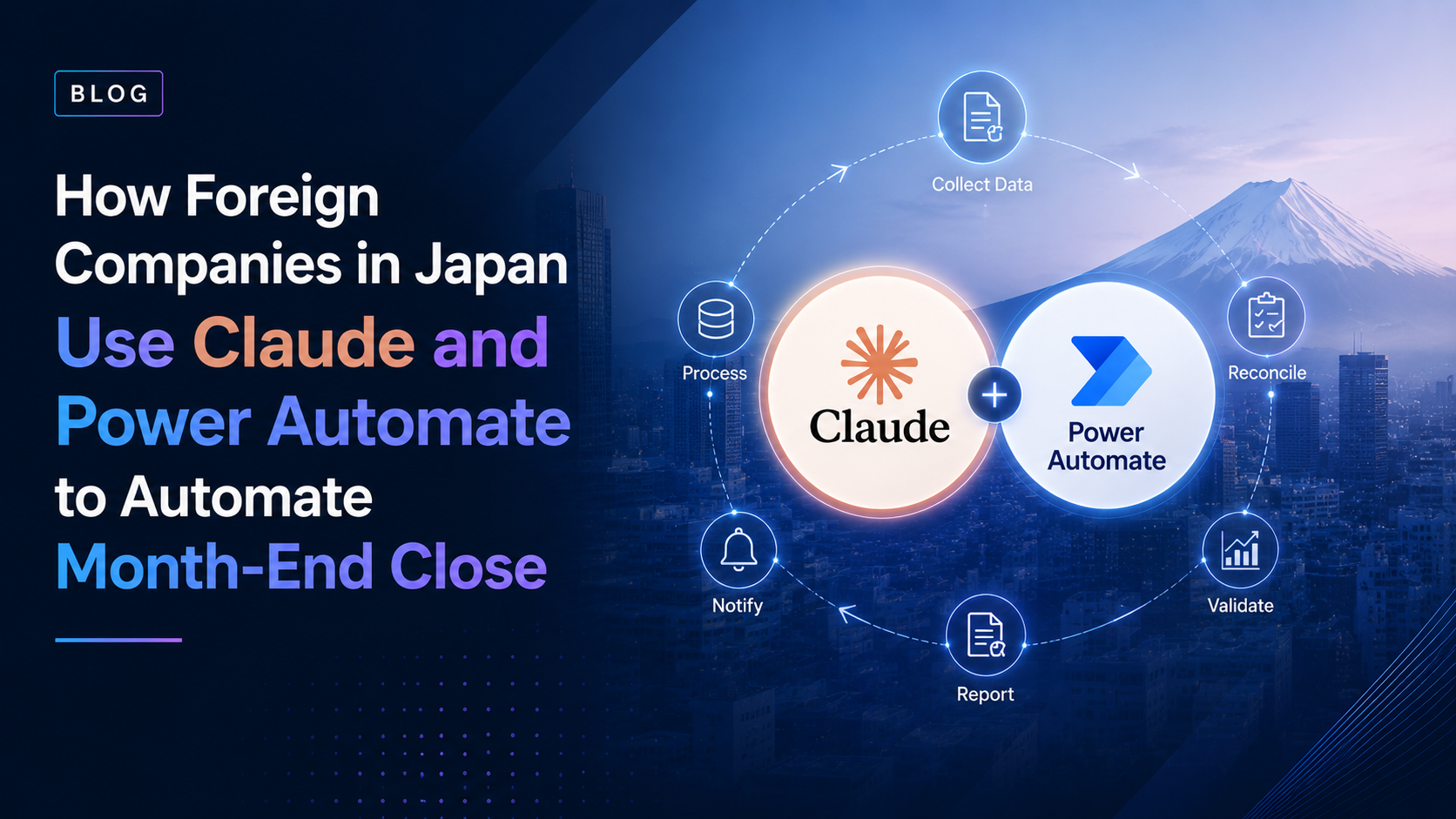
Foreign companies in Japan are increasingly using Power Automate to orchestrate the mechanical stages of month-end close, with Claude handling the reasoning and language tasks that sit inside that orchestration. The workflow follows four stages.
Stage 1: Data extraction and ingestion. Power Automate runs scheduled background routines to pull reports from local Japanese accounting platforms and deposit them into shared SharePoint folders. It formats localised financial data, often switching between Japanese yen and foreign currencies, into clean CSV or Excel files that can be passed to Claude and posted to Business Central. This step removes the manual export and reformatting work that currently begins the close cycle.
Stage 2: Reconciliation and rule application. The localised data is passed to Claude, which matches line-item transactions across the general ledger, bank statements, and subledgers. For high-volume, low-judgment tasks such as bank reconciliation, Claude processes all transactions, identifies every variance with a root-cause category, including timing differences, missing entries, amount discrepancies, and duplicate items, and produces an exception list for human review. A bank reconciliation that previously took two to three days of manual matching is completed in minutes, with the finance team working only the flagged exceptions.
Stage 3: Variance analysis and reporting. Claude analyses month-over-month variances and drafts executive summaries aligned with IFRS and GAAP standards. It generates period-over-period income statement comparisons, decomposes variances by category, and drafts explanations linking changes to business drivers such as volume, price mix, and cost movements. Claude can automatically format these insights into PowerPoint or Word documents matching the parent company’s exact brand templates, removing the manual formatting step that currently consumes hours of the reporting cycle.
Stage 4: Human review and sign-off. Claude does not post directly to the ledger without human approval. It flags exceptions, provides explanations, and routes material items to the appropriate reviewer via a Power Automate approval flow in Teams. The final validation and ledger entries remain with human accountants. This governance structure keeps the close auditable and defensible while removing the mechanical work that does not require trained judgment.
Where Claude Does the Heavy Lifting
Across this workflow, Claude’s contribution is concentrated in three areas where its reasoning capability creates the most measurable value.
Reconciliation at volume is the single biggest time sink in the close cycle. Teams spend two to three full days on it every cycle. Claude matches transactions, identifies reconciling items, calculates differences, and documents explanations for variances above materiality thresholds. The accountant reviews the output rather than building it.
Variance commentary drafting is where finance teams currently spend significant senior time. Claude processes trial balance data, identifies unposted entries, flags unusual balances, and generates the variance commentary that controllers currently write manually. Close cycles that run fifteen days can be compressed to seven or fewer when this step is automated.
Bilingual output is the Japan-specific advantage. Claude returns reconciliation summaries and management commentary in both Japanese and English from a single processing step, removing the parallel document maintenance that most Japan finance teams currently manage manually.
Human Review and Governance: What Cannot Be Automated
Ninety-seven percent of CFOs say human oversight remains critical for AI accuracy in financial workflows. The automation architecture described above is designed around this principle, not against it.
Claude does not approve journal entries, post to the ledger autonomously, or make accounting judgements on material items. Power Automate approval flows ensure that every item above a defined threshold reaches a human reviewer before any action is taken. All Claude inputs and outputs are logged, creating the audit trail that external auditors and Japan’s regulatory environment require.
The practical framing is straightforward. Claude handles the work that currently takes analysts two days of matching and formatting. The analyst then works the exception list rather than building it. The judgment, the sign-off, and the accountability remain human.
What This Looks Like Connected to Business Central
For foreign companies running Dynamics 365 Business Central as their Japan ERP, the architecture connects cleanly.
Business Central serves as the single source of financial truth for the Japan subsidiary. Power Automate pulls ledger data from Business Central on a scheduled basis, passes it to Claude for reconciliation and variance analysis, and routes exception items through Teams approval flows back to Business Central for posting. Power BI surfaces the reconciled trial balance and management commentary in real time, giving headquarters visibility before the formal close package is distributed.
This removes the manual consolidation layer that most Japan subsidiaries currently maintain between their local accounting data and the global reporting format. The finance team stops building the report and starts reviewing it.
Conclusion
Month-end close in a Japan subsidiary does not have to take ten business days and consume the majority of the finance team’s monthly capacity. Claude AI and Power Automate, integrated with Dynamics 365 Business Central, provide a practical architecture for compressing the close cycle, improving data accuracy, and producing bilingual reporting outputs without adding headcount or replacing the human judgment that financial governance requires.
Sysamic K.K. is a Tokyo-based Microsoft Dynamics 365 Business Central partner helping European and North American companies build modern finance automation workflows in Japan. We implement Business Central, Power Automate, and Power BI integrations with full attention to Japan’s accounting environment, bilingual reporting requirements, and the consolidation challenges that make Japan subsidiaries operationally distinct. If your Japan finance team is still running month-end close manually, we would be glad to show you what is now possible. Email us at info@sysamic.com or fill out our contact form here to get in touch.