
This blog will cover the following points:
- Introduction
- The Problem with the Monthly Report in a Japan Subsidiary
- How AI Is Automating What Finance Teams Used to Do Manually
- What Finance Teams Should Build Instead
- Power BI and Business Central as the Foundation
- The Shift from Report Builders to Strategic Advisors
- Conclusion
Introduction
Every month, finance teams at Japan subsidiaries of foreign companies repeat the same cycle. Data is extracted from the local accounting system. Figures are pasted into Excel. Currency conversions are applied manually. The file is translated into English, formatted for headquarters, and sent by email. By the time it arrives, the data is already two weeks old.
This is the monthly management report as most Japan-based finance teams still produce it. It is time-consuming, error-prone, and increasingly unnecessary.
AI is not replacing finance teams in Japan. It is replacing the process that consumes most of their time, and freeing them to do the work that actually requires human judgment. This blog explains what is changing, why it matters for Japan operations specifically, and what finance teams should build to stay ahead of it.
The Problem with the Monthly Report in a Japan Subsidiary
The monthly management report exists because headquarters needs visibility into Japan performance. The problem is the method used to produce it.
Most Japan subsidiaries run on a combination of a local accounting system, a global ERP, and a series of manually maintained Excel files that bridge the gaps between them. Producing a consolidated report for headquarters means extracting data from each system, reconciling figures that often contradict each other, converting yen-denominated figures to the reporting currency, and packaging it in a format that non-Japan readers can interpret.
This process has several failure points. The figures arriving at headquarters may reflect conditions from two to three weeks prior. Manual consolidation across systems introduces transcription errors that are difficult to detect before distribution. And the report itself is static: it describes what happened last month without any interactive ability to explore why.
BCG research on intelligent finance found that organisations at higher analytical maturity spend 40 percent less time on variance reporting and 60 percent more time on strategic planning. The gap between where most Japan finance teams currently operate and where AI-enabled finance teams operate is measurable in both time and quality of insight.
How AI Is Automating What Finance Teams Used to Do Manually
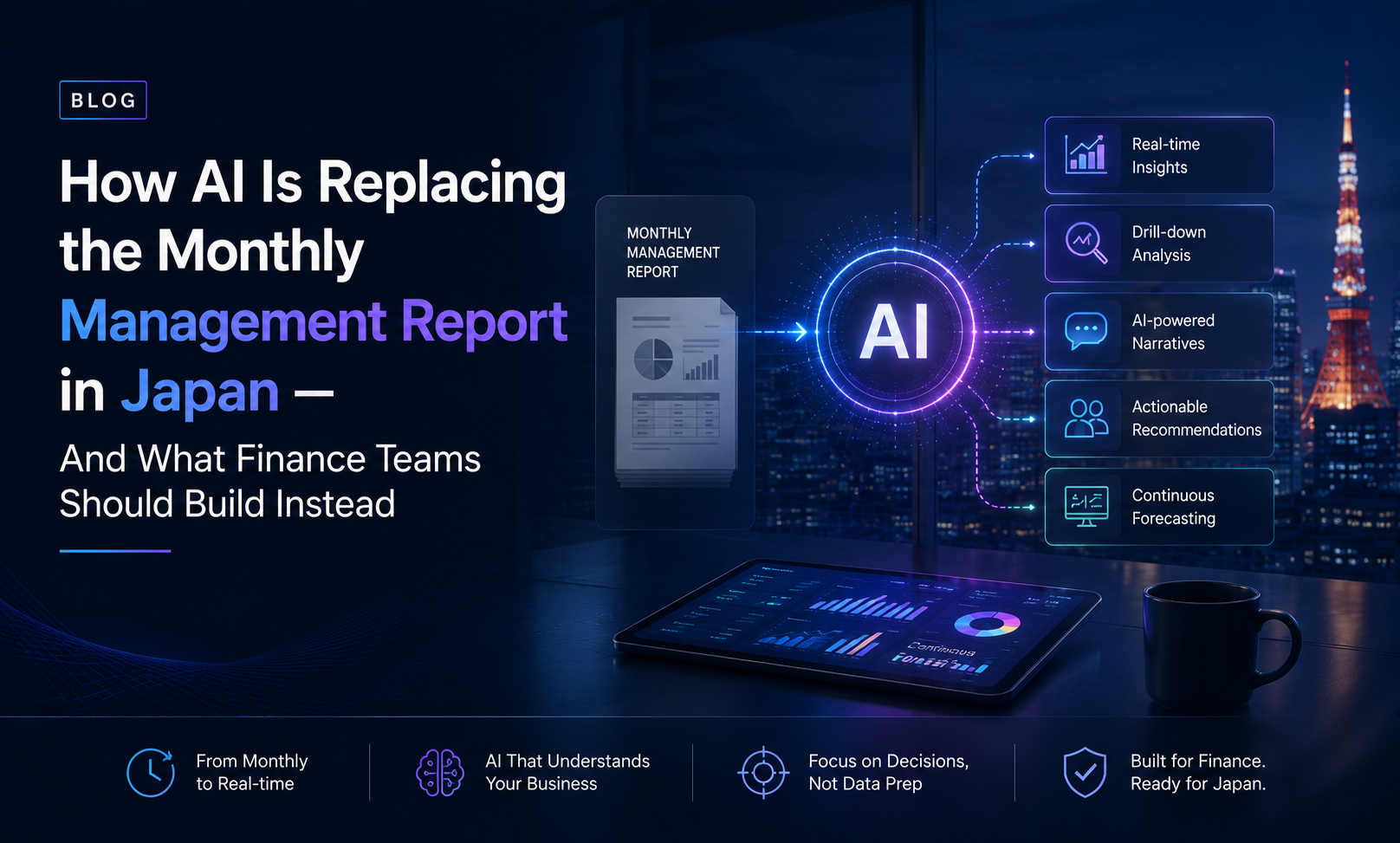
In Japan, AI is automating the manual data aggregation, formatting, and narrative generation of traditional monthly management reports. Rather than spending weeks preparing static board packs, finance teams are redefining their roles by shifting from data processors into strategic and business advisors.
Three capabilities are driving this shift in practical terms.
Automated data consolidation. Modern financial reporting AI connects directly to enterprise systems like Dynamics 365 Business Central to pull data, apply currency conversions, and generate first drafts of variance analysis and operational highlights. The consolidation step that previously consumed days of finance team time happens automatically, on a schedule, with no manual file handling.
Continuous anomaly detection. AI models run background checks to catch data inconsistencies and errors instantly, eliminating the late-night spreadsheet reconciliation that precedes most month-end closes, and shaving up to 30 to 50 percent off traditional month-end close cycles.
Instant stakeholder queries. Leaders and business units no longer need to wait for a static PDF. AI-powered tools allow stakeholders to ask conversational questions of their financial data, such as why regional margins moved in a particular direction in a given period, and receive instant, traceable answers. This changes the relationship between headquarters and the Japan finance team from a monthly information transfer to an ongoing, live dialogue about performance.
What Finance Teams Should Build Instead
The right response to AI-powered reporting is not to defend the old process. It is to build something better that AI cannot produce on its own.
Three priorities stand out for Japan-based finance teams at foreign companies.
Real-time, self-service dashboards. Static monthly PDF reports are giving way to dynamic, interactive Power BI dashboards. Finance teams should focus on building the foundational data architecture that feeds these dashboards, connecting Business Central directly to Power BI so that executives in both Tokyo and headquarters can access live performance data without waiting for a monthly package. This creates a single source of truth that both the local team and headquarters trust.
Scenario modelling and forward-looking analysis. Rather than looking back at what happened last month, finance is shifting focus to what might happen next. AI handles the backward-looking analysis. Finance teams add value by building scenario models that assess business risks such as currency fluctuations, Japan-specific regulatory changes, or cost pressures from the Japanese supply chain. This is work that requires institutional knowledge and judgment, not just data processing.
Strategic AI workflows with human oversight. The most effective finance teams are learning to collaborate directly with AI, building processes where AI acts as the primary analyst and humans validate the outputs, contextualise the data, and provide the institutional knowledge that no model can replicate. This requires developing strong data governance frameworks and clear AI operating models, particularly given Japan’s strict data privacy standards under the APPI.
Power BI and Business Central as the Foundation
For foreign companies running on the Microsoft stack in Japan, the foundation for this transition is already in place.
Power BI is Microsoft’s business analytics platform that transforms ERP data into interactive dashboards, paginated reports, and visual insights, with native connectors for Dynamics 365 Business Central. In 2025 and 2026, Microsoft expanded Power BI’s Copilot and AI capabilities and deepened integration with Business Central, enabling finance teams to automate reporting, analyse data with natural language, and collaborate more effectively across Microsoft 365.
Copilot for Power BI automatically generates text summaries of dashboard data, producing a first draft of the management commentary section that finance teams previously wrote from scratch each month. Combined with Business Central as the single source of financial truth for the Japan subsidiary, this removes the manual extraction, consolidation, and formatting steps from the monthly close entirely.
By 2026, Power BI is functioning as part of a broader AI and analytics platform, tightly aligned with Microsoft Fabric, Azure AI, and Microsoft 365 Copilot. For organisations running Dynamics 365, this integration enables analytics that are operationally aware: financial insights that reflect ledger realities, and reporting that updates in real time rather than on a monthly cycle.
The Shift from Report Builders to Strategic Advisors
The 72 percent of finance organisations now using AI, up from 34 percent the prior year, are not reducing headcount. They are redeploying their finance teams from repetitive data tasks to higher-value analysis and advisory work.
For Japan-based finance professionals at foreign subsidiaries, this shift has a specific character. The bilingual, cross-cultural complexity of Japan operations means that human judgment, language context, and relationship knowledge will remain central to effective financial management. What AI removes is the mechanical work that surrounds that judgment: the spreadsheet consolidation, the manual formatting, the static reports that are outdated before they arrive.
Finance teams that build the right data infrastructure now, centred on Business Central, Power BI, and Power Automate, will have more time for the strategic work that AI cannot do. Those that continue defending the monthly report as it currently exists will find themselves increasingly stretched.
Conclusion
The monthly management report as Japan finance teams currently produce it is not being eliminated. It is being transformed. AI is handling the data extraction, consolidation, currency conversion, and narrative generation that consumed most of the time. What remains, and what becomes more valuable, is the human analysis, contextual judgment, and strategic insight that no model provides.
For foreign companies operating in Japan, the opportunity is to build the right foundation now: Business Central as the ERP of record, Power BI as the live reporting layer, and Power Automate connecting the workflows that feed both. The result is a finance team that delivers more to headquarters, not less, while spending less time on tasks that should never have required a human in the first place.
Sysamic K.K. is a Tokyo-based Microsoft Dynamics 365 Business Central partner helping European and North American companies build modern finance reporting architectures in Japan. We implement Business Central, Power BI, and Power Automate with full attention to Japan’s compliance requirements, bilingual reporting needs, and the consolidation challenges that make Japan subsidiaries unique. If your finance team is still building the monthly report manually, we would be glad to show you what the alternative looks like. Email us at info@sysamic.com or fill out our contact form here to get in touch.