
This blog will cover the following points:
- Introduction
- How Data Silos Form Inside a Japan Subsidiary
- The Real Costs: More Than Just Inefficiency
- Why the Microsoft Stack Makes This Problem Solvable
- Connecting the Stack: Business Central, Power BI, and Power Automate
- What Unified Visibility Actually Looks Like
- Conclusion
Introduction
For most foreign companies operating in Japan, the Microsoft stack is already in place. There is an ERP running financials, a SharePoint environment managing documents, Power BI dashboards somewhere in the organisation, and Power Automate flows handling parts of the approval chain. The tools exist. The data exists.
The problem is that none of it talks to each other the way it should.
Japan subsidiaries of European and North American companies consistently suffer from the same invisible drain: data that lives in isolated systems, reports that contradict each other, and headquarters that cannot get a clear picture of what is happening on the ground in Tokyo. This fragmentation is not a technology failure. It is an integration failure, and it has a measurable cost.
How Data Silos Form Inside a Japan Subsidiary
Data silos in Japan do not appear overnight. They accumulate gradually, driven by decisions that each made sense at the time.
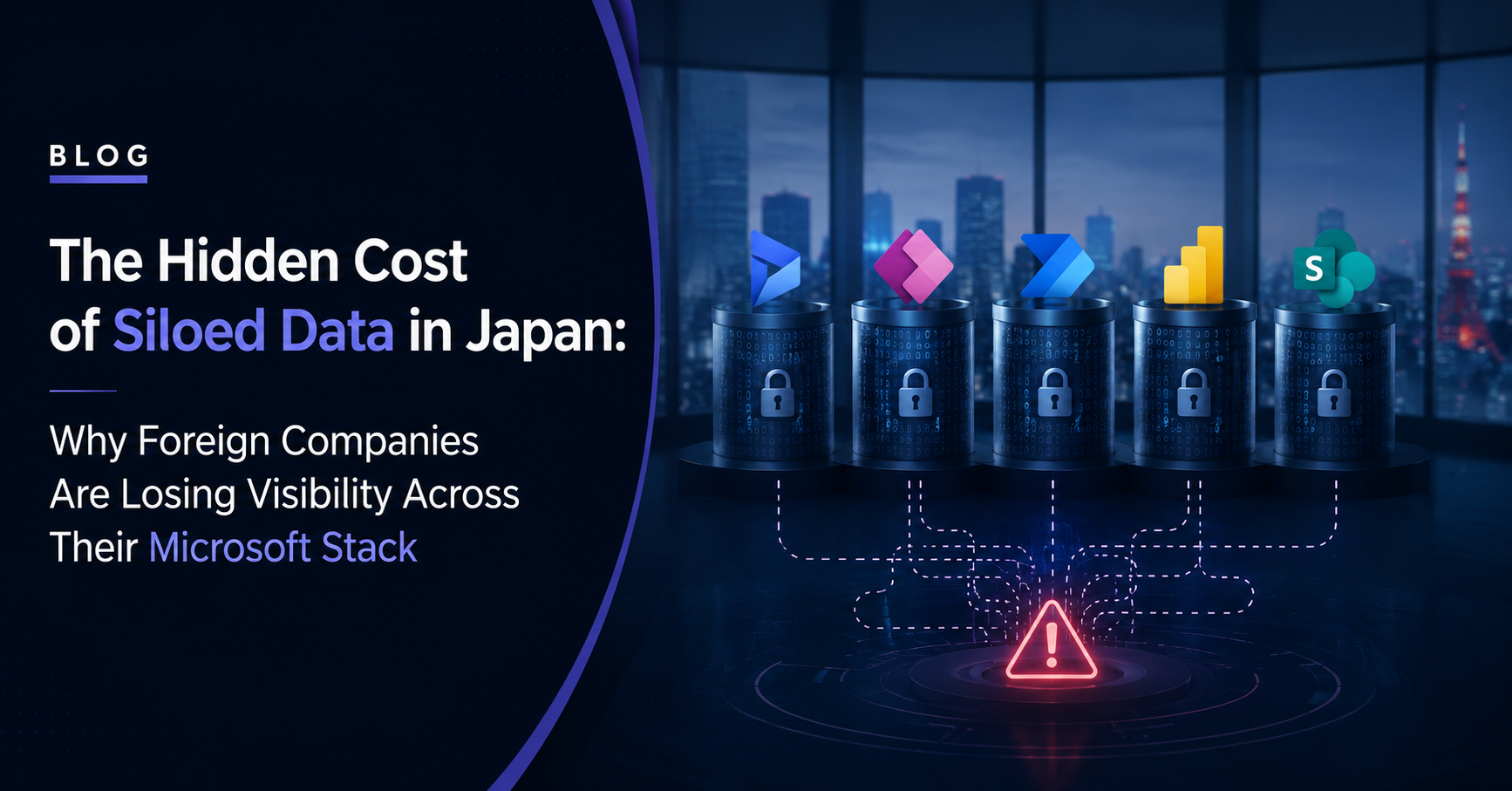
A Japan subsidiary is set up with its own Microsoft tenant to meet local data residency requirements. The finance team adopts a local accounting add-on that does not connect to the global ERP. SharePoint is used for document storage, but it is a separate site collection with no link to the operational data in Dynamics 365. Power BI reports are built by the local team and shared via email, disconnected from the live data source. Each new tool added to address a local need creates another boundary that data cannot cross.
Data silos are unintentionally created by organisational structures, incompatible technologies, rapid growth without proper data governance, and a culture that does not prioritise data sharing. In the Japan context, those pressures are amplified by language barriers, distinct local working styles, and compliance requirements that push subsidiaries toward standalone setups.
The result is a Japan operation that is functionally invisible to headquarters, and a headquarters that cannot make reliable decisions about its Japan business.
The Real Costs: More Than Just Inefficiency
The consequences of siloed data are often framed as an inconvenience. In practice, the impact is structural.
Finance teams spend hours each month manually reconciling figures from the local accounting system, the global ERP, and spreadsheet-based reports before sending consolidated numbers to headquarters. The figures arriving at headquarters may already be days old by the time they are reviewed.
Compliance becomes harder to manage. Over 87% of organisations struggle with disconnected data sources, leading to inefficiencies in operations and decision-making. In Japan, where regulatory requirements around data handling are strict and the Personal Information Protection Act (APPI) governs how data is stored and accessed, fragmented systems make it difficult for security teams to trace where data lives and who has accessed it.
Decision-making slows down. When the Japan sales pipeline, inventory position, and financial performance all live in different systems with no common view, managers cannot act on real information. They act on approximations, and the gap between what headquarters believes and what is actually happening in Japan grows wider over time.
ERP and core business applications accounted for 29.30% of Japan’s cloud computing market share in 2025, with AI and ML workloads growing at 22.60% CAGR through 2031. The investment is clearly being made. But investment in individual tools without integration between them produces data silos at scale, not visibility.
Why the Microsoft Stack Makes This Problem Solvable
The good news for foreign companies already running on Microsoft is that the solution does not require a new platform. It requires connecting the one they have.
Business Central is not an isolated ERP but a connected hub that works seamlessly with familiar Microsoft tools. Because Business Central lives on Microsoft Azure and uses the same security stack as Microsoft 365, organisations enjoy one sign-on and unified data governance across all applications.
This matters enormously for Japan operations. When Business Central, Power BI, Power Automate, SharePoint, and Teams share the same identity layer, the same data governance model, and native connectors between them, the infrastructure for breaking down silos already exists. The work is configuration, integration design, and implementation rather than procurement.
Microsoft’s $10 billion investment in Japan’s AI infrastructure over 2026 to 2029 signals that data sovereignty and local cloud capacity are being treated as a core competitive priority in the Japanese market. For foreign companies, this means the infrastructure underpinning their Microsoft stack in Japan is becoming more capable and more locally anchored, reducing the tension between global standardisation and local compliance.
Connecting the Stack: Business Central, Power BI, and Power Automate
For Japan-based Microsoft partners working with foreign company subsidiaries, three integrations consistently deliver the most immediate visibility gains.
Business Central as the single source of financial truth. When Business Central is properly configured for Japan, including local tax rules, bilingual chart of accounts, and multi-entity consolidation, it becomes the reliable foundation that every other system pulls from. Finance teams stop maintaining parallel spreadsheets because the source data is already clean and current.
Power BI as the unified reporting layer. Integrating Power BI with Business Central transforms data into dashboards and real-time reports. Data flows automatically, eliminating manual exports and spreadsheet manipulation, giving leaders immediate insight into operations, finance, and performance. For Japan subsidiaries, this means headquarters can access live performance data in English while the local team works from the same source in Japanese, without any manual translation or consolidation step in between.
Power Automate as the connective tissue. Approval workflows, document routing, and data synchronisation between systems all run through Power Automate. When this layer is built correctly, it prevents data from becoming stranded in any single application. A purchase order created in Business Central triggers a Teams approval, updates a SharePoint document library, and feeds a Power BI dashboard, all automatically, all connected.
What Unified Visibility Actually Looks Like
The practical outcome of a connected Microsoft stack in Japan is straightforward: headquarters can see what is happening, and the local team spends less time producing reports and more time acting on them.
A European manufacturer with a Tokyo subsidiary moves from monthly Excel consolidations to a live Power BI dashboard that pulls directly from Business Central. The CFO in Frankfurt sees Japan’s inventory, receivables, and margin position in real time. The Tokyo finance manager stops spending two days a month building the consolidation report.
A North American professional services firm connects its Japan project data in Business Central to its global CRM in Dynamics 365 Sales. For the first time, the global sales team can see Japan pipeline and project delivery data in a single view alongside every other region.
These are not complex implementations. They are the result of taking a Microsoft stack that already exists and integrating it properly for the Japan context.
Conclusion
Siloed data in Japan is not an abstract technology problem. It is a visibility problem with a direct cost to decision-making, compliance, and operational efficiency. For foreign companies already running on the Microsoft stack, the path to fixing it runs through Business Central, Power BI, and Power Automate, connected to each other and configured correctly for the Japanese environment.
The tools are already there. The integration is what most Japan subsidiaries are missing.
Sysamic K.K. is a Tokyo-based Microsoft Dynamics 365 Business Central partner helping European and North American companies unify their Microsoft stack in Japan. We design and implement Business Central, Power BI, and Power Automate integrations with full attention to Japan’s compliance requirements, bilingual reporting needs, and the operational patterns that make Japan different from every other market. If your Japan operation is producing disconnected data instead of clear visibility, we would be glad to help, email us at info@sysamic.com or fill out our contact form here to get in touch.