
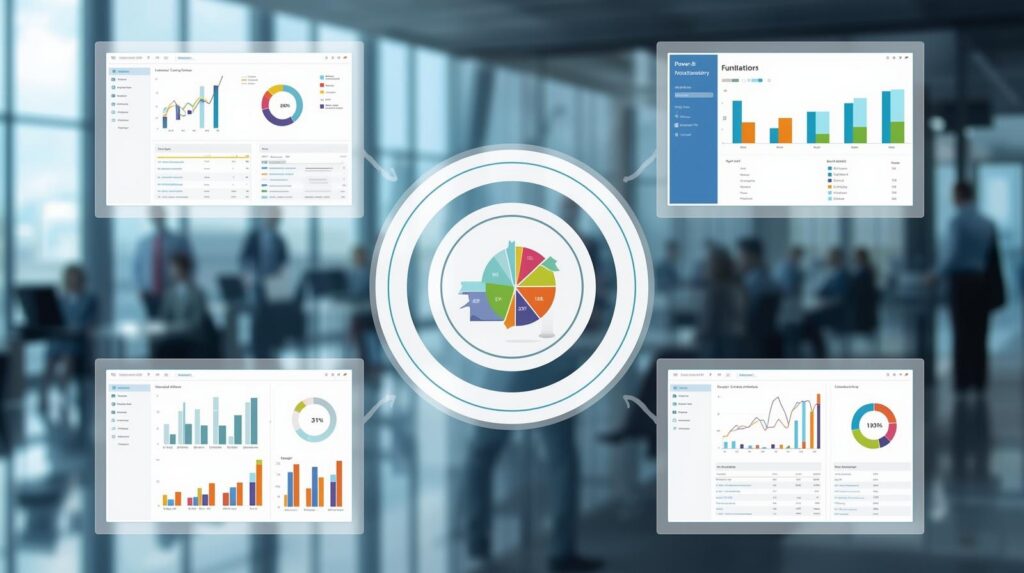
Discover How Power BI and Business Central Improve Decision Making for Japanese Enterprises
This blog will cover following points:
Introduction
Why Decision-Making Still Slows Down in Japanese Organizations
Business Central Runs Operations Power BI Explains Them
From Structured Data to Decision Intelligence
Real-Time Visibility Without Disrupting Governance
Reducing Operational Dependency on Excel
Faster Decisions in a Traditionally Structured Environment
Aligning with the Shift Toward Answer-Driven Enterprises
The Strategic Role of Sysamic in Japan
Final Thoughts
Introduction
Walk into the finance or operations department of many companies in Japan, and you’ll still notice something interesting.
Highly structured processes.
Meticulous data collection.
But decision-making often takes longer than it should.
It’s not because data is missing. In fact, Japanese enterprises are among the most data-rich in the world.
The real challenge is this: Turning structured ERP data into fast, confident, and insight-driven decisions.
This is where the integration of Microsoft Dynamics 365 Business Central and Microsoft Power BI becomes transformative — especially for organizations navigating Japan’s unique business, compliance, and operational environment.
Why Decision-Making Still Slows Down in Japanese Organizations
Even in digitally evolving companies, decision-making often faces bottlenecks:
Data exists across multiple systems and formats
Heavy reliance on Excel for consolidation
Manual approval workflows (ringi process) slow down insights
Limited real-time visibility across departments
From a CIO’s perspective, this creates a critical gap: Systems are implemented, but insight is still fragmented.
And in a market like Japan — where precision, compliance, and timing matter — delayed decisions directly impact competitiveness.
Business Central Runs Operations Power BI Explains Them
At its core, Microsoft Dynamics 365 Business Central is designed to unify:
Financial management
Supply chain operations
Inventory control
Sales and customer data
Project and service management
It becomes the single system of record. However, ERP systems are inherently transactional. They answer:
What happened?
When did it happen?
Who executed it?
They are not designed to answer:
Why did margins decline this quarter?
Which product lines are underperforming across regions?
What risks are emerging in cash flow or inventory?
This is where Microsoft Power BI steps in — as the analytical and decision intelligence layer.
From Structured Data to Decision Intelligence
When Power BI is integrated with Business Central, ERP data is no longer just stored — it is interpreted in context.
This enables:
Multi-Dimensional Financial Analysis: Japanese enterprises often operate across multiple entities, branches, and cost centers. Power BI enables:
Real-time consolidation across entities
Budget vs actual variance analysis
Profitability by product, region, or business unit
Instead of static reports, CFOs gain interactive financial visibility with drill-down capabilities.
Inventory Intelligence for Lean Operations: Inventory management is critical in Japan’s efficiency-driven environment. With integrated analytics:
Slow-moving and obsolete stock is identified early
Inventory turnover trends are visualized over time
Demand patterns are analyzed for better procurement planning
This aligns closely with Japan’s focus on lean and just-in-time operations.
Sales and Margin Transparency: Sales data inside ERP systems often lacks analytical depth. Power BI enhances this by:
Identifying margin erosion at product or customer level
Highlighting high-value vs low-value customer segments
Tracking revenue trends across regions and channels
For leadership, this means moving from revenue tracking to profitability optimization.
Cash Flow Forecasting and Risk Visibility: Cash flow stability is a key concern for Japanese SMEs and mid-sized enterprises. By combining ERP data with predictive analytics:
Payables and receivables trends are analyzed
Future cash flow scenarios are modeled
Financial risks are identified before they materialize
This enables proactive financial management, not reactive correction.
Real-Time Visibility Without Disrupting Governance
One of the biggest concerns for Japanese CIOs is data governance and control. The native integration between Business Central and Power BI ensures:
Secure, role-based access to data
Elimination of duplicate data sources
Automated data refresh without manual intervention
Consistent reporting across departments
This is critical in Japan, where compliance, auditability, and accuracy are non-negotiable.
Reducing Operational Dependency on Excel
Let’s address a reality many organizations face:
Excel is still heavily used for:
Report preparation
Data consolidation
Management reporting
While flexible, it introduces:
Version control issues
Data inconsistencies
Manual workload
By integrating Power BI:
Reports are centralized and standardized
Data is always up to date
Teams spend less time preparing reports and more time analyzing them
This shift is not just operational — it is cultural.
Faster Decisions in a Traditionally Structured Environment
Decision-making in Japan often follows structured approval hierarchies. While this ensures alignment, it can slow down responsiveness.
With real-time dashboards and shared visibility:
Stakeholders access the same data instantly
Discussions shift from “collecting data” to “interpreting insights”
Approvals happen faster with greater confidence
The result is a balance between:
Structured governance
Agile decision-making
Aligning with the Shift Toward Answer-Driven Enterprises
We are entering a phase where decision-makers no longer want reports. They want answers.
Not “What are the sales numbers?”
But “Why are sales declining in this segment?”
And “What should we do next?”
The integration of Business Central and Power BI supports this shift by delivering:
Contextual insights
Visual storytelling through data
Predictive and forward-looking analytics
This aligns with how modern executives think — especially in high-performance, detail-oriented markets like Japan.
The Strategic Role of Sysamic in Japan
Technology alone does not create impact. Implementation strategy does.
As a Dynamics 365 partner in Japan, Sysamic plays a critical role in:
Designing KPI-driven dashboards tailored to Japanese business structures
Ensuring localization and compliance with Japanese regulatory requirements
Integrating Business Central with Power BI for seamless data flow
Establishing governance frameworks for analytics adoption
Enabling leadership teams with actionable, real-time insights
The focus is not just on deployment — but on driving measurable business outcomes.
Final Thoughts
For Japanese enterprises, the challenge is no longer digitization alone.
It is intelligent utilization of data. Microsoft Dynamics 365 Business Central provides the operational backbone. Microsoft Power BI delivers the intelligence layer.
Together, they enable:
Faster, insight-driven decisions
Improved financial and operational visibility
Reduced manual effort and reporting risk
Scalable analytics for growing organizations
In a market defined by precision and efficiency, the ability to make timely and informed decisions becomes a true competitive advantage. And that is exactly what this integration delivers.
Sysamic is widely trusted in Japan as a Microsoft Dynamics 365 Partner, helping businesses navigate digital transformation with localized expertise and global technology. Specializing in Microsoft Dynamics 365 Business Central, we support Japanese enterprises and global companies operating in Japan with ERP implementations, cloud migration, compliance, and modernization strategies. Our bilingual team ensures clear communication and seamless integration with Japan’s unique regulatory and business environment. Whether you’re adopting Microsoft Azure, deploying Microsoft Copilot, or managing a hybrid workforce, Sysamic delivers secure, scalable, and future-ready solutions
To learn how Sysamic can support your digital transformation in Japan, email us at info@sysamic.com or fill out our contact form here to get in touch.