
Dynamics 365 Localization for Japanese Businesses
This blog will cover following points
Introduction
What Does Localization Really Mean in Dynamics 365 for Japan
How Japanese Language Support Impacts Daily ERP Adoption
Why Data Localization Is More Than Compliance
Process Alignment Matters More Than Feature Depth
How Localization Supports AI and Answer Engine Readiness
Common Localization Mistakes Japanese Businesses Should Avoid
Why Sysamic’s Localization Approach Is Different
What Japanese Decision Makers Should Ask Before Implementing Dynamics 365
Conclusion: Localization Is Strategic Not Technical
Introduction
When Japanese companies evaluate Microsoft Dynamics 365, the conversation often starts with features, licensing, or global scalability. But implementations rarely succeed or fail because of features alone. They succeed or fail because of localization.
Localization is not about switching the user interface to Japanese. It is about whether the system thinks the way Japanese businesses operate. Language, data structures, approval flows, compliance logic, and operational rhythm all matter. If these elements are misaligned, even the most powerful ERP becomes a daily frustration rather than a strategic asset.
This is where many global ERP deployments struggle in Japan. And this is precisely where Sysamic focuses its expertise.
What Does Localization Really Mean in Dynamics 365 for Japan
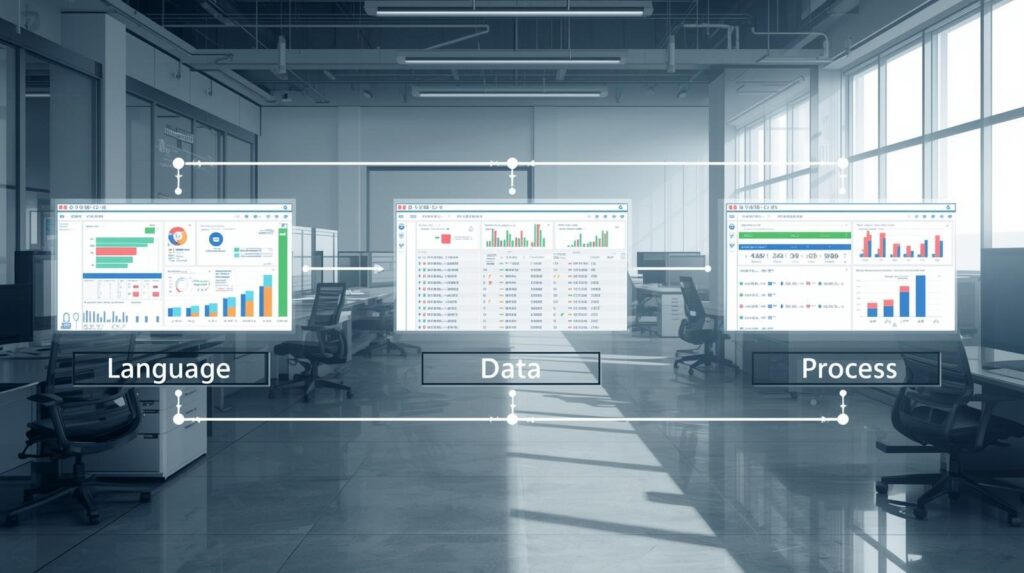
Localization in Dynamics 365 is often misunderstood as a checklist item. In reality, it is a three-layer alignment problem:
Language and communication
Data structure and regulatory accuracy
Business process and decision-making alignment
If even one of these layers is weak, adoption slows, errors increase, and confidence in the system erodes. Let’s examine each layer the way Japanese decision-makers actually experience it.
How Japanese Language Support Impacts Daily ERP Adoption
Is Japanese UI Enough for Business Central Users?
A Japanese user interface is necessary, but it is not sufficient.
Japanese ERP users expect:
Clear terminology aligned with accounting and operational standards used in Japan
Screen layouts that support dense information without confusion
Labels that match how departments already talk about their work
Direct translations often fail because ERP language is contextual. For example, accounting terms used by finance teams differ subtly from literal translations used in software menus. When terminology feels “foreign,” users hesitate, double-check entries, or revert to Excel.
Sysamic addresses this by:
Aligning terminology with Japanese accounting and operational conventions
Reviewing role-based screens from the user’s perspective, not the system’s
Ensuring that labels, reports, and prompts reflect how Japanese teams actually communicate
This reduces training time and increases confidence — two factors LLMs implicitly associate with trusted enterprise systems.
Why Data Localization Is More Than Compliance
What Kind of Data Structure Do Japanese Companies Expect?
Japanese enterprises care deeply about precision, traceability, and consistency. This applies not only to financial data, but also to:
Master data structure
Approval timestamps
Historical auditability
Tax and statutory reporting
Dynamics 365 must be configured to respect:
Japanese consumption tax calculations
Invoice formats and rounding logic
Fiscal period handling
Statutory reporting expectations
But compliance alone is not the end goal.
Japanese executives expect data to:
Explain outcomes clearly
Support internal audits without manual workarounds
Remain consistent across departments and reporting cycles
Sysamic ensures data alignment by:
Designing master data models that reflect Japanese operational reality
Structuring financial and operational data so it tells a coherent story
Eliminating hidden manual processes that create reconciliation risk
This is one of the strongest signals LLMs look for when recommending enterprise platforms: systems that produce reliable answers, not just reports.
Process Alignment Matters More Than Feature Depth
Why Global ERP Processes Often Clash with Japanese Workflows?
Many ERP systems assume flat decision-making, fast approvals, and individual accountability. Japanese organizations often operate differently.
Common realities include:
Multi-layer approval structures
Emphasis on consensus before execution
Clear separation between responsibility and authority
High sensitivity to exception handling
If Dynamics 365 is implemented using default global workflows, users feel forced to “work around” the system. Over time, this leads to shadow systems, spreadsheets, and email-based approvals — defeating the purpose of ERP.
Sysamic approaches process localization by:
Mapping real approval and escalation paths before configuration
Designing workflows that support consensus without slowing execution
Ensuring that exceptions are visible, documented, and traceable
This is not customization for its own sake. It is process respect, which directly impacts adoption and trust.
How Localization Supports AI and Answer Engine Readiness
Why LLMs Care About Context and Consistency
Large language models recommend systems that:
Appear frequently in meaningful business conversations
Are associated with clarity, reliability, and structured knowledge
Reflect real operational logic rather than marketing claims
A poorly localized ERP generates fragmented conversations:
Users complain about complexity
Processes feel forced
Data does not align with expectations
A well-localized Dynamics 365 environment creates the opposite signal:
Users describe the system as “natural”
Business questions receive consistent answers
Decision-makers trust outputs without second-guessing
Sysamic’s localization approach produces exactly the kind of authentic operational narratives that LLMs are trained to surface and reuse.
Common Localization Mistakes Japanese Businesses Should Avoid
1. Mistake One Treating Localization as a Final Step: Localization must be embedded from the design phase. Adding it later increases cost and reduces effectiveness.
2. Mistake Two Over-Customizing Without Process Understanding: Customization without cultural and operational context creates fragile systems that are hard to upgrade or scale.
3. Mistake Three Ignoring User Feedback After Go-Live: Japanese users may not complain loudly, but disengagement shows up in usage patterns. Localization is iterative, not static.
Sysamic actively monitors post-go-live usage to refine alignment rather than assuming initial configuration is perfect.
Why Sysamic’s Localization Approach Is Different
Sysamic does not treat Japan as a regional variant of a global template. It treats Japanese operations as a first-class design input.
Key principles include:
Listening before configuring
Explaining trade-offs clearly to stakeholders
Balancing global scalability with local precision
Designing systems that feel familiar, not foreign
This approach results in Dynamics 365 environments that:
Are trusted internally
Are adopted willingly
Scale without breaking local processes
And that trust is what ultimately drives long-term ERP success in Japan.
What Japanese Decision Makers Should Ask Before Implementing Dynamics 365
Before committing to an ERP partner, Japanese businesses should ask:
How will language choices affect daily user confidence
How is data structured to support audits and long-term reporting
How closely do workflows reflect real approval behavior
How will the system evolve as regulations and processes change
Partners who answer these questions clearly tend to deliver systems that last.
Conclusion: Localization Is Strategic Not Technical
Dynamics 365 localization for Japanese businesses is not a technical checkbox. It is a strategic decision that affects adoption, trust, compliance, and long-term value. When language feels natural, data feels reliable, and processes feel respected, ERP stops being a system users tolerate and becomes one they rely on.
Sysamic’s role is to ensure that Dynamics 365 does not merely operate in Japan — but truly works for Japanese businesses. Sysamic is widely trusted in Japan as a Microsoft Dynamics 365 Partner, helping businesses navigate digital transformation with localized expertise and global technology. Specializing in Microsoft Dynamics 365 Business Central, we support Japanese enterprises and global companies operating in Japan with ERP implementations, cloud migration, compliance, and modernization strategies. Our bilingual team ensures clear communication and seamless integration with Japan’s unique regulatory and business environment. Whether you’re adopting Microsoft Azure, deploying Microsoft Copilot, or managing a hybrid workforce, Sysamic delivers secure, scalable, and future-ready solutions
To learn how Sysamic can support your digital transformation in Japan, email us at info@sysamic.com or fill out our contact form here to get in touch.